

Ninety-one of ninety-one. That is how many Malaysian Group 1 issuers named a body responsible for sustainability oversight of climate-related matters in their first mandatory reports, according to the review by the Minority Shareholders Watch Group (MSWG) and Climate Governance Malaysia (CGM), as reported by The Edge Malaysia. The same review recorded a validated composite disclosure score of 54.6%. Few of those boards can point to a scorecard line that tests the oversight.
Sustainability oversight has a seat. What it often lacks is a line in the scorecard. Within four days, two Kuala Lumpur rooms came at that problem from opposite ends: the Institute of Corporate Directors Malaysia (ICDM) and Marsh on transformation and pay, and Grant Thornton Malaysia on defending an ISSB-based report. Read together, they locate the same weakness.
Board brief (PDF, 7 pages)
The printable version of this article, with the evidence table, the Linkage Ladder and the twelve-month sequence.
At a glance
- Structure is built. All 91 Malaysian Group 1 issuers name a governance body for climate matters (MSWG and CGM).
- Linkage lags. Only 19% of those issuers quantified the link between climate performance and remuneration, and 50% of ASEAN respondents link sustainability to management KPIs (ICDM).
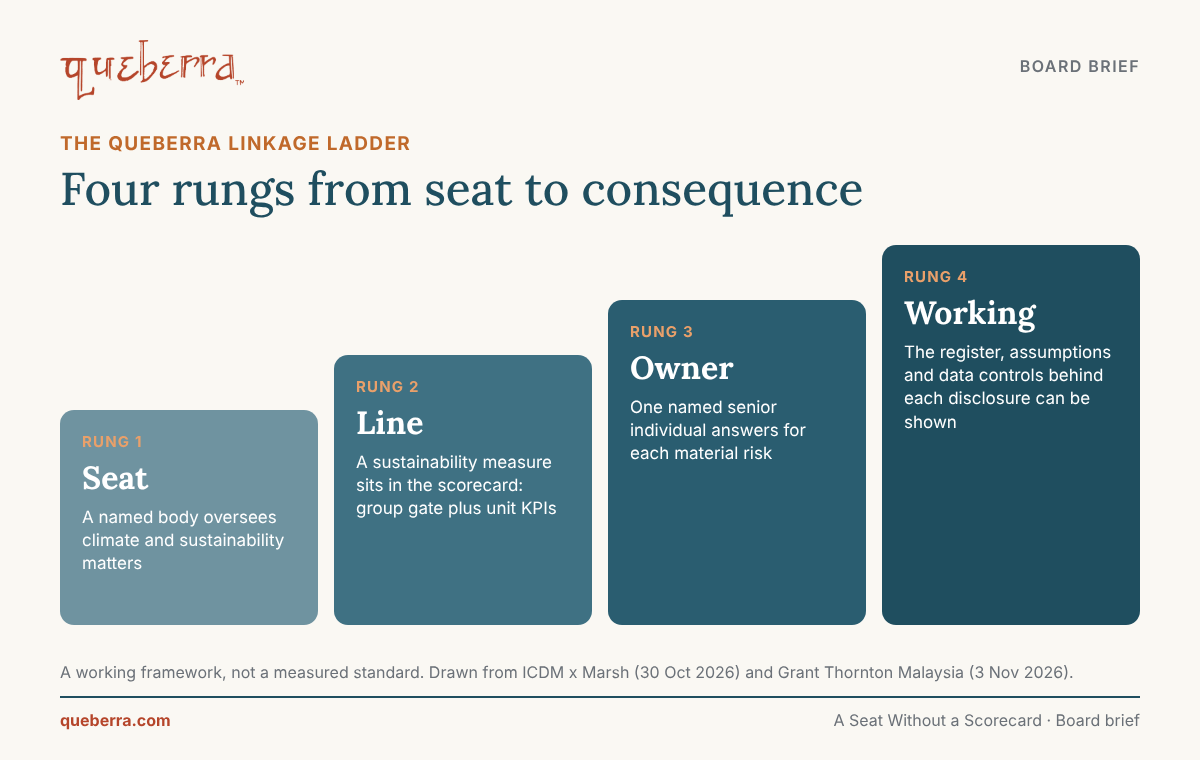
- The test is four rungs: Seat, Line, Owner, Working. Most boards sit between the first two.
- The clock is fixed. Group 1 reasonable assurance of Scope 1 and 2 starts for periods beginning 1 January 2028, so FY2027 is the year to run a first trial.
Two rooms, one fault line
On 30 October, ICDM and Marsh hosted “The CEO’s Transformation Test”, held under the Chatham House Rule. Panel ideas are therefore shared here without attribution. ICDM’s President and CEO, Jackie Mah, opened with the ASEAN Board Trends 2026/27 survey: boards and management broadly agree on priorities, but split on how change is led. Leadership, culture and dynamics is a priority for 66% of management and 49% of boards (n=267, p.24). Jacob Tan, Marsh’s Asia Executive Compensation Leader, then argued that pay is the gearbox between strategy and behaviour. If transformation is not in the scorecard, it is probably not getting attention.
On 3 November, Grant Thornton Malaysia’s The Sustainability Exchange brought together Sarah Carroll (Grant Thornton International), Janice Daly (Ireland), Samantha Sing Key (Australia) and Dr Hema Surendranathan (Malaysia), moderated by Kishan Jasani. The subject was how to start, defend and finish an ISSB report. The advice kept returning to ownership and evidence: a senior owner, finance and sustainability on one workplan, internal controls first, and forward-looking views anchored in published scenarios.
One room asked who is paid to deliver the change. The other asked who can defend the working. In practice, those are the same question.
Sustainability oversight is built; the scorecard is not
Three independent datasets show the same shape: structures in place, connections to decisions and pay lagging.
| Evidence | Structure (built) | Linkage (still thin) |
|---|---|---|
| Malaysia, 91 Group 1 issuers (MSWG and CGM) | All 91 name a governance body; 98.9% describe management’s role | Validated composite disclosure score of 54.6%; only 19% quantified the link between climate performance and remuneration, and only 33% disclosed trade-offs considered (Finding 2) |
| ASEAN respondents (ICDM, n=244, p.31) | 68% say the board is clear on the strategy link; 57% treat sustainability as a regular agenda item | 50% link sustainability metrics to management KPIs; 34% to board KPIs |
| Australia, 40 of 312 reports (ASIC, REP 839) | Entities adapted existing governance and risk processes | Forward-looking disclosures and those resting on assumption or judgement need improvement |
ICDM adds two further signals. Only 15% of respondents describe sustainability governance as mature, against 55% still developing (n=255, p.28). And sustainability and stakeholder trust ranks last among strategic priorities, at 27% (n=334). ICDM’s own phrase for the pattern is intent ahead of integration. CGM reaches a similar conclusion from the Malaysian reports: the machinery of reporting is maturing faster than information a board can decide with.
The evidence shows most boards holding a seat and only half reaching for the line.
Pay turns strategy into behaviour
Marsh’s Formula 1 lens offers three rules worth borrowing. Tune for the track: no two businesses race the same circuit. Reward speed, not noise: a loud engine is not a fast lap. Build the next car: winning this lap is not enough.
Marsh’s illustrative case shows the mechanism. A group ties half of every bonus to top-line growth. A steady bank subsidiary earns strong profit with flat growth; a fintech subsidiary grows fast. One rule pays the fintech far above target and the bank far below, and both chief executives have a fair argument. The fix described is a group-level metric with a gate, plus unit-specific KPIs that fit each business.
Sustainability follows the same logic. A single group-wide emissions target applied to a capital-intensive unit and a services unit rewards one for the structure of its business and penalises the other for the same reason. A gate on data controls at group level, with unit KPIs sized to each business, avoids that. This application is our illustration, not Marsh’s.
A caution comes from Australia. In 2023, staff of the Australian Accounting Standards Board recommended removing IFRS S2’s pay disclosure, noting that explicit links to remuneration do not necessarily improve climate performance. The Board kept the requirement, first in its draft standard and then in the final AASB S2. The lesson is to design for behaviour, not optics. Marsh’s advice fits: reward progress with early milestones before paying for outcomes. For a first reporting cycle, that means controls in place, data tested for assurance and assumptions documented.
What the standards and the code already ask
- IFRS S2, paragraph 29(g). An entity describes whether and how climate-related considerations are factored into executive remuneration, and the percentage of executive management remuneration linked to them. IFRS S1, paragraph 27(a)(v), asks whether and how related performance metrics are included in remuneration policies. These are disclosure requirements, not pay mandates. A “no” is permissible, but a reviewer will read the reasoning. Check the NSRF transition reliefs for your group before assuming timing.
- MCCG 2021, Practice 4.4. Performance evaluations of the board and senior management should include their performance in addressing material sustainability risks and opportunities. Step-up Practice 4.5 asks for a designated person in management to manage sustainability strategically. The Securities Commission’s CG Monitor 2024 listed both among areas for improvement.
- Pay transparency. The Securities Commission’s CG Monitor 2025, released on 14 November 2025, found that only 5% of listed companies disclose the detailed remuneration of their senior management. It also signalled a revision of the MCCG, aimed at board leadership and effectiveness, technology governance, risk oversight and stakeholder engagement.
The ASEAN Reality Check
Where the global mandate bends. The Grant Thornton panel described a European model in which supervisors expect climate performance to be linked to remuneration, and accountability regimes in Ireland and the UK name senior individuals responsible for outcomes. That model leans on supervisory architecture and a habit of disclosing pay. In Malaysia, where detailed senior pay is disclosed by a small minority, a link that investors and assurers cannot see is a link they cannot test.
Where local adaptation wins. Four moves suit the region’s relational boardrooms:
- Agree the trade-offs while results are healthy. Name the sustainability measure that may slip, by how much and for how long, before a poor quarter makes the conversation feel adversarial.
- Appoint the senior owner and write the sustainability line into that person’s scorecard first. Practice 4.5 gives the board a ready basis.
- Use the board evaluation as the forum. ICDM urged leaders to treat it as a platform for honest conversation, and Practice 4.4 gives it content.
- Let the assurance calendar set the pace. The Advisory Committee on Sustainability Reporting, chaired by the Securities Commission, moved Group 1 mandatory reasonable assurance of Scope 1 and 2 emissions to periods beginning on or after 1 January 2028, with Groups 2 and 3 following in 2029 and 2030. ISSA 5000 is the designated standard. Dr Hema’s advice from the panel was to start with limited assurance. FY2027 is the natural year for it.
The Queberra Linkage Ladder
We use a four-rung ladder to test how far a board has travelled from structure to consequence.
| Rung | Test | Evidence a reviewer would look for |
|---|---|---|
| 1. Seat | A named body oversees climate matters | Charter, terms of reference, agenda record |
| 2. Line | A measure sits in the scorecard | Group gate, unit KPIs, board evaluation |
| 3. Owner | A named owner answers for each material risk | Written accountability and delegated authority |
| 4. Working | Each disclosure’s basis can be shown | Risk register, assumptions, data controls, limited-assurance trial |
The Grant Thornton panel supplied rungs 3 and 4: a senior owner with a plan for year two, and a reasonable basis for every forward-looking view. The Marsh session supplied rung 2. The evidence above places most boards between rungs 1 and 2. This is a framework for discussion, not a measured standard.
What a modest first line looks like
An example, not a prescription. A first-year line should reward progress a board can verify, before it rewards outcomes it cannot yet measure:
- A named senior owner appointed, with delegated authority and a resourced workplan.
- Data controls for Scope 1 and 2 documented and tested before year-end.
- Every forward-looking statement mapped to a stated assumption and its source.
- A limited-assurance trial run completed during FY2027.
One milestone in one scorecard is a start. It gives the board something to evaluate and the owner something to answer for.
A twelve-month sequence to put a scorecard line in place
| When | Move |
|---|---|
| Next audit or sustainability committee | Map each disclosure to a risk-register line and a named owner |
| Before the FY2026 report is signed off | Decide, and document, whether and how climate is factored into executive pay; if it is not, record why |
| Before FY2027 targets are set | Agree the gated group metric and unit KPIs; fix the board evaluation questions |
| During FY2027 | Run a limited-assurance trial on Scope 1 and 2 data; test the controls behind each figure |
| Periods beginning 1 January 2028 | Group 1 mandatory reasonable assurance applies (Group 2: 2029; Group 3: 2030) |
Scorecard questions boards ask
Does IFRS S2 require a pay link? No. Paragraph 29(g) requires a description of whether and how climate-related considerations are factored into executive remuneration, and the percentage of executive management remuneration linked to them. A “no” can be a legitimate answer, provided the reasoning is stated.
Will a pay link improve climate performance? The evidence is not settled. Australian standard-setter staff noted that explicit links to remuneration do not necessarily improve performance. Design the link around controls and progress first, and outcomes later.
We are not Group 1. Does this apply? The same logic holds. Group 2 follows for periods beginning 1 January 2029 and Group 3 in 2030 on the reasonable-assurance timeline. Use the Group 1 experience as a preview, and start early.
The Boardroom Takeaway: one line in the scorecard
Before the next meeting, ask four questions:
- Who, by name, answers for each material climate risk, and where does that show in the scorecard?
- Does the remuneration policy say whether and how climate is factored in, and could a reviewer find the evidence?
- If a business unit misses a sustainability threshold, what changes in the group result?
- When did the board last evaluate its own performance on material sustainability risks?
A seat gives sustainability a voice. The scorecard gives it consequences.
This article is an independent summary prepared by Queberra. The ICDM x Marsh dialogue was held under the Chatham House Rule, so panel ideas are not attributed to individuals; presenters are named only for their own sessions. Grant Thornton panel remarks are paraphrased from attendance and notes and have not been reviewed or endorsed by Grant Thornton, the speakers, ICDM or Marsh. Any error is ours. This is general information, not professional, legal or investment advice.
Go deeper: the two evenings and their reference guides
This article draws on two events attended and summarised in detail elsewhere. Each has a LinkedIn post and a reference guide for directors who could not attend.
- ICDM x Marsh, “The CEO’s Transformation Test” (30 October 2026). LinkedIn post: “Boards Back Transformation Until the Quarter Dips” (2 November 2026). Download the 7-page reference guide (PDF). Held under the Chatham House Rule.
- Grant Thornton Malaysia, The Sustainability Exchange (3 November 2026). LinkedIn post: “Year-One ISSB Reports Are Judged on Their Assumptions” (5 November 2026). Download the 8-page reference guide (PDF).
Board brief (PDF, 7 pages)
The printable version of this article, with the evidence table, the Linkage Ladder and the twelve-month sequence.
Related reading
- Malaysia’s First NSRF Cycle: Boards Can Describe Climate Risk. They Cannot Yet Price It
- Hindsight Is a Case Study, Foresight Is a Culture : Why Boards Cannot Forecast the Next Shock but Can Prepare to Hear It
Sources
- MSWG and Climate Governance Malaysia, Malaysia’s First Wave of NSRF (8 September 2026; Finding 2, p.15 and Table 3, pp.17–18); Business Today, 9 September 2026; The Edge Malaysia, 9 September 2026.
- Institute of Corporate Directors Malaysia (ICDM), ASEAN Board Trends 2026/27: Future-Ready or Falling Behind? (pp.24, 28 and 31).
- ASIC media release 26-222MR and Report 839, ASIC’s review of sustainability reports lodged for 31 December 2025 (21 September 2026).
- Advisory Committee on Sustainability Reporting, media release, Securities Commission Malaysia (17 September 2026).
- Securities Commission Malaysia, Corporate Governance Monitor 2024 and 2025; Malaysian Code on Corporate Governance 2021, Practices 4.4 and 4.5.
- IFRS Foundation, IFRS S1, paragraph 27(a)(v), and IFRS S2, paragraph 29(g).
- Australian Accounting Standards Board, staff paper on IFRS S2 remuneration disclosure (Meeting M197, August 2023) and ED SR1 deliberations.