
Malaysia’s first mandatory climate-disclosure cycle just delivered its verdict: our listed companies can describe risk fluently. They cannot yet price it.
Minority Shareholders Watch Group (MSWG) and Climate Governance Malaysia (CGM) reviewed 91 of Malaysia’s biggest listed companies. Overall, they scored 54.6% on disclosure quality. The real story is in the pattern behind that number.
The Reality Check: What the Numbers Actually Mean
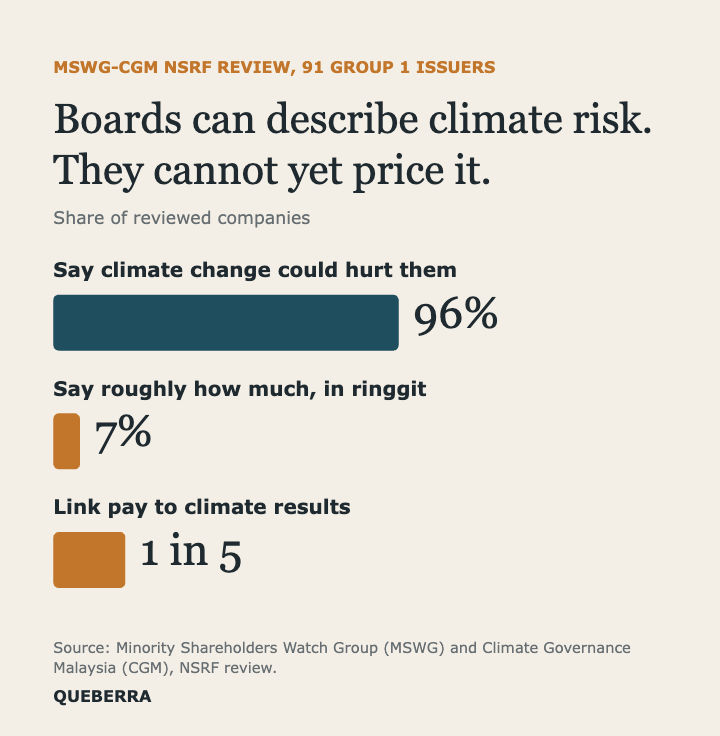
96% of companies say climate change could hurt them. Only 7% say roughly how much, in ringgit. That’s a storm warning with no word on whether it means a leaky roof or a collapsed building.
Every company names someone in charge of climate risk. Only 1 in 3 show that person actually weighing a hard choice. Only 1 in 5 link pay to climate results.
Companies spot danger well. They track progress poorly — they can say what might go wrong, but rarely whether things are getting better or worse.
Most problems cluster in five areas: targets, resilience, industry data, financial impact, and emissions reporting. Fix five things, not fifty.
CGM did the maths most companies haven’t done for themselves. Nine large, profitable companies already have a break-even carbon price below RM155 per tonne of emissions — meaning even a modest carbon tax, not a drastic one, would wipe out an entire year’s profit. That is not a 2030 problem. It is a decision boards should be making now.
The Boardroom Takeaway:
A rough number beats a nice paragraph. Saying “this could cost us tens of millions of ringgit” tells investors more than “climate change poses risks to our business” — even when the number isn’t exact.
Show the committee’s homework. Don’t just say a committee oversees climate risk — say what it decided: money approved, a target set, a risk walked away from. A board that meets is not the same as a board that acts.
Flooding is a money problem, not just a weather one. Bank Negara Malaysia puts insured cover for the December 2021 floods at only about a third of total losses. Uninsured disasters don’t disappear — the cost lands on companies, banks, then taxpayers.
“No carbon tax yet” isn’t a reason to wait. It’s coming — only the timing is unsettled. Planning now is cheaper than reacting later.
Watch for incomplete numbers dressed up as good ones. Many companies only count their own emissions, not their suppliers’ and customers’ (“Scope 3”). Leaving that out can make a company look cleaner than it is.
This report doesn’t grade anyone pass or fail. That’s what makes it useful — an honest snapshot of a market still learning to turn good intentions into real numbers.
Where does your company sit — still describing the risk, or already putting a number on it?
Source: Minority Shareholders Watch Group (MSWG) and Climate Governance Malaysia (CGM), National Sustainability Reporting Framework (NSRF) review of 91 Group 1 listed issuers.