

Contractors and contract values will be disclosed once the Government Procurement Act takes effect in 2027. That is the quietest and most consequential line in Malaysia’s Budget 2027 papers: the Budget Speech, The Fifth MADANI Budget, delivered in the Dewan Rakyat on 9 October 2026, together with the Ministry of Finance’s Economic Outlook and Fiscal Outlook. It sits beside a number the Ministry wants to move: Malaysia ranks 54th of 182 on the Corruption Perceptions Index 2026, a score of 52, with the aim of reaching the top 25 (Economic Outlook, p.26).
This review sets out what the papers say, who the measure reaches, what is still open, and how I would read it from the boardrooms I know in Malaysia and Indonesia. It is the long version of my LinkedIn post.
What I read, and what I did not
I worked from four Ministry of Finance documents: the Budget Speech, the Economic Outlook, the Fiscal Outlook and the tax measures annex. I also read the Securities Commission and Bursa Malaysia statements and the Budget commentaries from PwC, KPMG, BDO and Baker Tilly. Page references below are PDF page numbers.
Three limits shape how the findings should be read. I have not seen the Government Procurement Act itself, only the Ministry’s description of it. I have not seen any commencement notice or regulations. And the Government-Owned Entities Bill has no draft, so nothing can be said about its text. This is a reading of intentions and stated timing, not of rules in force.
Five signals the papers give, in my words
- Procurement now leads the integrity agenda: it is the first ongoing effort listed under the National Anti-Corruption Strategy 2024 to 2028, ahead of oversight mechanisms and integrity management (Economic Outlook, p.27).
- The disclosure law exists: the Government Procurement Act 2026 (Act 882) was gazetted on 26 May 2026 and is to take effect in 2027 (Fiscal Outlook, p.46; Speech, p.89).
- Disclosure reaches projects, contractors and contract values, so price becomes public information (Speech, p.89).
- State-linked buyers are being re-papered: GLC procurement guidelines, not reviewed since 2006, are to be updated from 2027 (Speech, p.32).
- The wider public sector is next: a Government-Owned Entities Bill will be drafted for government companies and statutory bodies (Speech, p.88).
The Act: what the Ministry describes
The Fiscal Outlook sets out the Act in an information box. Its coverage follows the public money: procurement funded wholly or partly by Federal or State funds or assets is in scope (p.47). A procuring entity includes the Federal Government, State Governments, federal statutory bodies, local authorities and implementing agencies (p.47 to 48). State contracts therefore count as much as federal ones.
| Item | What the papers say (page) |
|---|---|
| Act | Government Procurement Act 2026 (Act 882), gazetted 26 May 2026 (Fiscal Outlook, p.46) |
| Structure | 12 Parts and 93 sections; supplier and contractor registration in sections 14 to 27 (Fiscal Outlook, p.46) |
| Timing | Comes into force in 2027 (Speech, p.89); expected to come into force in 2027 (Economic Outlook, p.148) |
| Disclosure | Project information, including contractors and contract values (Speech, p.89) |
| GLC guidelines | Not reviewed since 2006; updated from 2027; vendors judged on growth, innovation and market reach (Speech, p.32) |
| Government-Owned Entities Bill | To be drafted (Speech, p.88) |
Two procurement choices beside disclosure
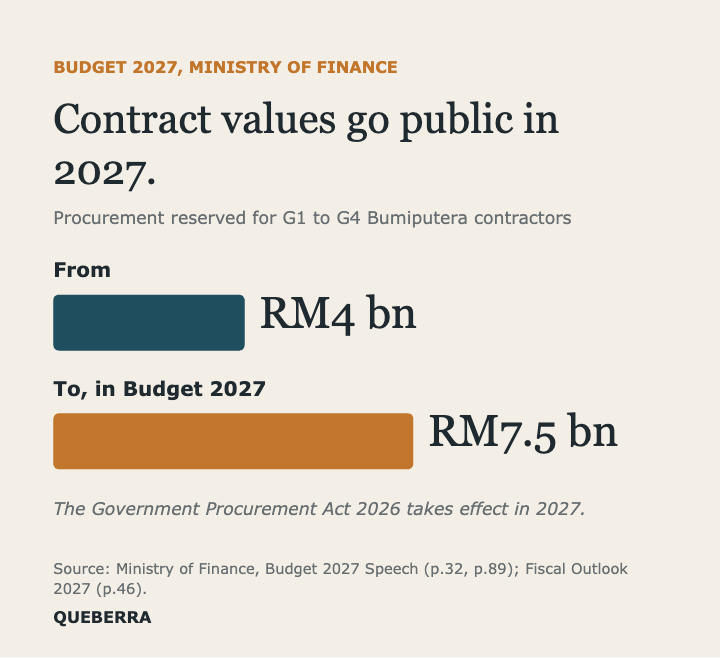
Two procurement choices sit beside disclosure. Procurement reserved for G1 to G4 Bumiputera contractors rises to RM7.5 billion from RM4 billion, and GLCs and Petronas target RM45 billion of procurement from Bumiputera companies. For maintenance, repair and upgrading works on government facilities, direct award is allowed up to RM200,000 and quotation up to RM3 million (all Speech, p.32). Wider access and faster routes are policy choices. They also raise the stakes on documentation, because each direct award becomes visible once disclosure begins. RM1.1 billion is allocated to MACC, the police, the trade and cost-of-living ministry, Customs and the Competition Commission (Speech, p.89 to 90).
Read together, the three procurement choices carry different documentation burdens:
| Route or measure | Amount or threshold | What a board should document |
|---|---|---|
| Reserved procurement, G1 to G4 Bumiputera contractors | RM7.5 billion, up from RM4 billion | Eligibility, registration status and subcontracting chain |
| GLC and Petronas procurement from Bumiputera companies | Target of RM45 billion | Vendor performance against growth, innovation and market reach |
| Direct award, maintenance, repair and upgrading of government facilities | Up to RM200,000 | Justification for the route and the price basis |
| Quotation, maintenance, repair and upgrading of government facilities | Up to RM3 million | Comparison of quotes and the selection record |
Two seats: the seller and the buyer
For the seller, disclosure turns a contract into a reference point. Your price becomes readable by a competitor, a journalist or the next buyer. The papers name contractors and contract values; whether partners and agents also become visible will depend on the final rules. A figure that sat in a contract folder becomes the opening position in the next negotiation. That is a commercial matter before it is a legal one.
For the buyer, the reach is wider than the contract list. GLCs and state-linked bodies will be buying under new criteria while the Government-Owned Entities Bill is still being drafted. A supplier who can explain growth, innovation and market reach, and not only price, will be better placed under the revised guidelines.
Where the global mandate breaks, and where local adaptation wins
International open-contracting practice assumes a settled legal text, a published standard and a mature enforcement layer. Here the Act is gazetted but not yet in force, the Government-Owned Entities Bill is not drafted, and the papers I read do not set out how disclosure will work in practice. PwC Malaysia’s Budget commentary says success will depend on timely legislation, clear guidance and rigorous execution. That is a general comment on the Budget, not on this Act, but it describes the test well.
Local adaptation wins by preparing early. Disclosure standards tend to converge on a common core: who was paid, how much, for what, and through whom. A company can build for that core now and adjust when the commencement notice sets the detail.
What is still open
- The commencement date and any phasing of the disclosure obligation.
- What is published, at what level of detail, and what may be withheld.
- How state-level procurement will be aligned with the federal framework.
- The scope, text and director-level provisions of the Government-Owned Entities Bill.
- How the revised GLC guidelines will weigh growth, innovation and market reach against price.
Beyond the post: what a procurement exposure register looks like
The LinkedIn post asks five questions. The practical answer to all five is one page the board sees every quarter. It is my own working framework, not a government template, and it is built to fit a board that meets six to eight times a year and has no dedicated committee for the topic.
- Contract and counterparty: the customer, the contract reference and the term.
- Funding source: federal, state, GLC or GLIC, because coverage follows the money.
- Value and award route: open tender, quotation or direct award.
- Business owner: one named executive, not a function.
- Agents, subcontractors and joint-venture partners behind the contract, with the basis on which each was appointed.
- Disclosure exposure: what a reader would see if the contract were published tomorrow.
- Pricing precedent: how this price compares with other customers and with earlier awards.
The register works because it converts a diffuse topic into a standing agenda item with a name beside every line. It also surfaces what boards most often lack: a single view of how much revenue depends on the state and its linked companies.
A sequence for the next three board meetings
- Meeting one: receive the first register. Do not debate the policy. Check that every government, state and GLC contract is on it, and ask only who owns each line.
- Meeting two: test pricing and margins as if every value were public, and review agents and subcontractors against a disclosure standard, not only an anti-bribery clause.
- Meeting three: agree the owner, the escalation path and the first statement the company would make if a figure were questioned.
- At commencement: compare the notice with the register and close the gaps.
- Six months after: review revenue concentration and pricing against the first public disclosures.
The sequence assumes no new committee. Audit, risk and the commercial committee each touch the topic, so one named director should hold the file.
How the lens shifts by type of board
The same measure lands differently depending on who sits at the table. This is my own synthesis, not a regulator classification.
| Board type | What to check first | Why it matters |
|---|---|---|
| Private equity and portfolio boards | Government revenue and award route for each portfolio company | Disclosure turns contract value into a valuation input |
| Family-owned and SME boards | Whether pricing and agent arrangements are written down | Informal practice is the most exposed once values are public |
| GLC and state-linked boards | Vendor selection against the revised guidelines due from 2027 | Growth, innovation and market reach join price as criteria |
| Listed company boards | Whether government concentration is disclosed and owned at committee level | Revenue dependence on the state is a risk-disclosure question |
How the wider Budget reads across the six disciplines
The Budget is wider than procurement. This table reads each measure through the six disciplines and asks what a board should do with it.
| Discipline | Budget measure | Board implication |
|---|---|---|
| Governance | Procurement disclosure; Government-Owned Entities Bill; RM1.1 billion for enforcement agencies | Move procurement from the compliance file to the board agenda |
| Strategy | Revised GLC guidelines; Bumiputera procurement targets | Position the firm as a supplier on the new criteria |
| People | Minimum wage RM1,700 to RM2,000 from June 2027 (MSMEs under RM50 million in sales exempt); living wage of RM3,400 for around 230,000 GLC and GLIC workers | Re-cost labour-heavy contracts before pricing becomes public |
| Climate and ESG | Green criteria in procurement under Treasury circular PP/PK 1.9 (Economic Outlook, p.39) | Expect sustainability evidence in bids |
| AI and innovation | Sovereign AI cloud being planned; RM30 million MDEC fund to help 4,000 MSMEs adopt AI and to train 5,000 AI professionals | Watch for AI-related public demand and skills support |
| Transformation | Financing guarantees for mergers and acquisitions and a proposed matching grant for listing costs under the Malaysia and Hong Kong dual-listing pathway (Bursa Malaysia commentary); proposal to strengthen the Global Services Hub incentive (tax measures annex) | Capital-markets and structuring options for growth-stage firms |
Questions to take into the next board meeting
- Which government, state and GLC contracts make up our revenue?
- If every contract value were published tomorrow, would our pricing hold up?
- Do our agents and subcontractors meet the same standard we do?
- Which director owns this file?
- What do we say first if a figure is questioned?
A note on method
Figures are taken from the Ministry of Finance Budget 2027 documents listed below, as read on 11 October 2026. Where the Speech and the Outlook differ in wording on timing, I have followed the Speech and flagged the difference. Legislative wording may change before commencement. This article is general commentary, not legal or financial advice.
The Boardroom Takeaway
Transparency changes the customer before it changes the law. A board that has read its own government contracts the way a regulator would will treat the commencement notice as confirmation, not news.
When did your board last see every government contract on one page?
This article was first shared on LinkedIn: https://lnkd.in/p/geJmK_wn
Related reading
- Only 7% of ASEAN Boards Govern AI Formally : Why the Region Needs a Register Before a Committee
- Boards Recruit for Fit, Then Fault the Gaps : Why Chemistry Without Capability Is a Governance Risk
- The “Passive” Board is Dead
Sources
- Ministry of Finance Malaysia, Budget Speech 2027, The Fifth MADANI Budget (English), 9 October 2026.
- Ministry of Finance Malaysia, Economic Outlook 2027.
- Ministry of Finance Malaysia, Fiscal Outlook 2027, Information Box on the Government Procurement Act 2026 (Act 882).
- Ministry of Finance Malaysia, Budget 2027 tax measures annex.
- Securities Commission Malaysia, media release welcoming Budget 2027; Bursa Malaysia statement on Budget 2027.
- Budget 2027 commentaries by PwC Malaysia, KPMG Malaysia, BDO Malaysia and Baker Tilly Malaysia.