

PwC’s 2026 Annual Corporate Directors Survey, based on about 600 US public company directors surveyed in September 2026, contains a pairing every nomination committee should sit with. When evaluating prospective directors, 81% say alignment with the board’s culture and ways of working is very important. Only 27% say the same about specialised expertise such as AI or cybersecurity.
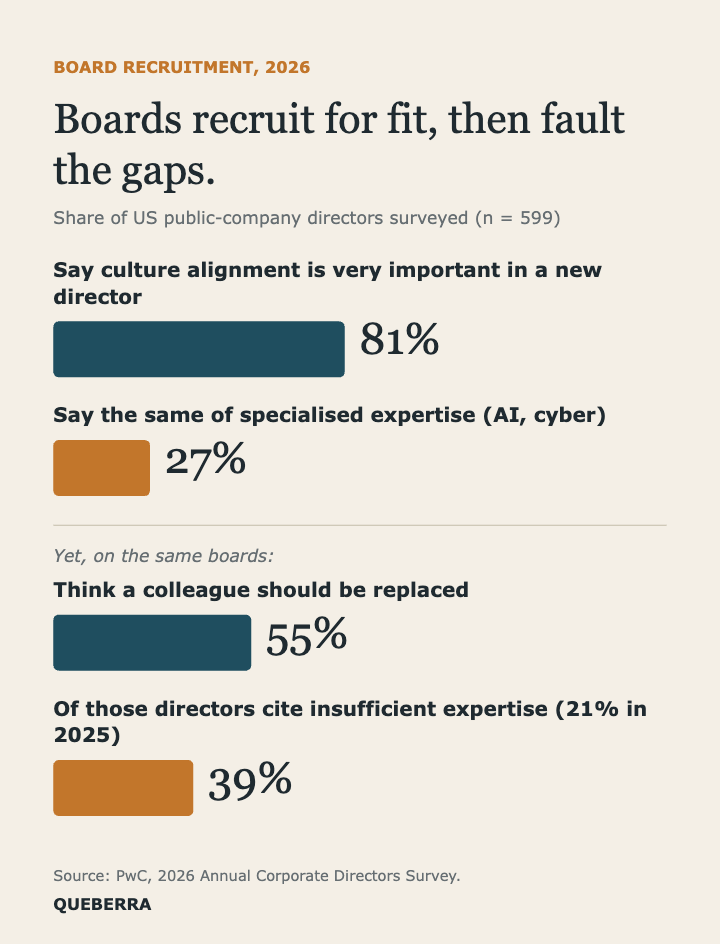
The same survey shows why that matters. Consistent with last year, 55% of directors think someone on their board should be replaced. Among them, 39% cite insufficient expertise as the primary reason, up from 21% in 2025. Only 36% of those directors say their boards factor skill gaps into succession planning.
Boards, in other words, are diagnosing a skills problem and prescribing chemistry.
What the Survey Found
71% of directors name AI as the leading skill their boards need to strengthen. 73% say board assessment processes could improve, and 49% say assessments are not sufficiently candid. Forty percent of directors who flagged limits on candour say an independent third party would strengthen it. 81% say their boards can more effectively challenge management on corporate strategy.
The ASEAN Reality Check
This is a US sample, so it should not be read as a Malaysian finding. The pressure points do travel. On 3 July 2026 the Securities Commission Malaysia opened a public consultation, which closed on 31 July, setting out four proposals. Two sit close to this discussion: greater guidance on governance expectations for listed companies with concentrated ownership, and board oversight expectations for technology and artificial intelligence, including disclosure. The final outcome had not been published at the time of writing.
Here the global mandate breaks. The US answer to a weak seat is replacement: refresh, reassess, rotate. In closely held companies, a seat often carries history and relationships, and replacement is rarely the first option. Local adaptation wins by building capability around the seat. Keep the relationships that hold the company together, and add the competence the agenda now demands.
Four Moves for the Next Board Cycle
First, publish a skills matrix next to the director biographies. Name what each seat is there to supply, and use the matrix when planning succession.
Second, test fit as behaviour. Can this person disagree well, in a way the room will actually hear?
Third, bring in an outside facilitator for the annual board assessment. It addresses the candour problem directly.
Fourth, borrow expertise before you hire it. A standing panel of specialists in AI, cyber and climate can brief the board while its composition evolves.
The Boardroom Takeaway
Culture decides how a board behaves. Capability decides whether it behaves wisely.
When did your board last appoint someone who made the room less comfortable and the decisions better?
Source: PwC, 2026 Annual Corporate Directors Survey (full PDF report); Securities Commission Malaysia media release, 3 July 2026.
Related reading: The AI Governance Gap · The Risk Paradox · The “Passive” Board is Dead.