
On 11 November 2026, Nvidia’s board accepted Jensen Huang’s resignation as President, CEO and director, effective immediately. Eleven days later, on 22 November, the same board voted unanimously to reinstate him. It announced the decision the next day. Both halves of that board reversal came before the board’s own findings.
Between those two decisions sat an independent investigation, led by Wachtell Lipton. It has not concluded. In the company’s own words, it “will proceed to conclusion.”
Key takeaways
- Both of Nvidia’s board decisions, the exit and the return, came before its own investigation reported.
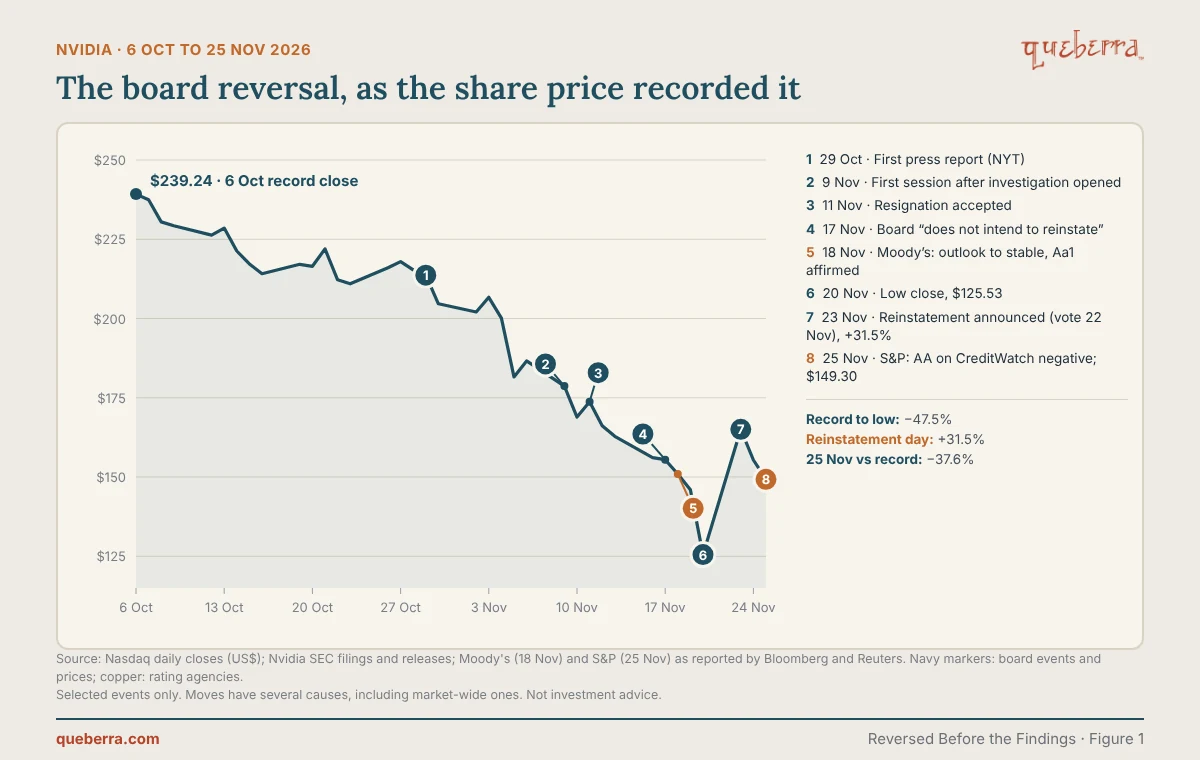
- The shares fell from a record $239.24 (6 Oct) to $125.53 (20 Nov), down 47.5%. Reinstatement lifted them to $165.05 (23 Nov), up 31.5% in a day but still 31% below the record. By 25 Nov they had eased to $149.30.
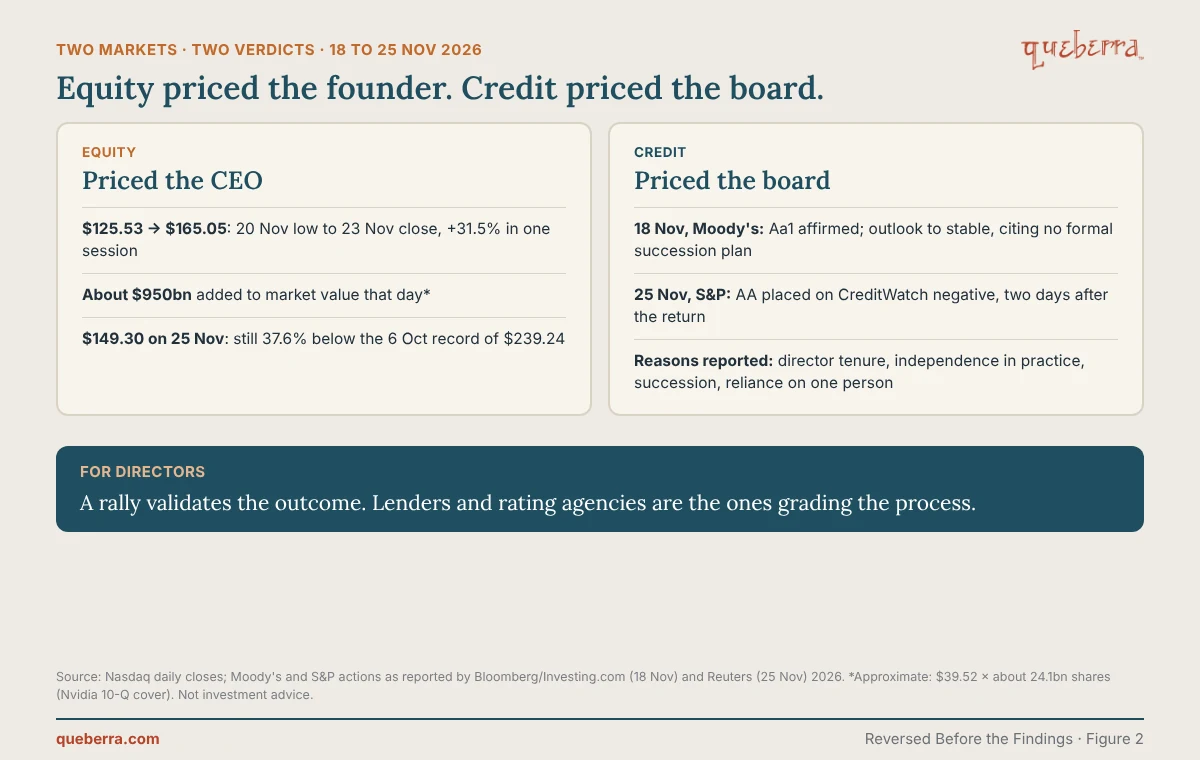
- Credit read it differently. S&P placed the AA rating on CreditWatch negative two days after the return, citing the board, not the CEO.
- In Singapore, proposals published on 27 October would make a lead independent director mandatory where the chair is not independent. The structure helps; the judgement still has to be exercised.
- Five questions to answer before any board reversal.
Most commentary has asked whether the board got the second decision right. We think that is the wrong question. Both decisions were taken before the findings. The lesson for boards, in Santa Clara and in Singapore, is not about direction. It is about sequence.
What the record shows
The public record is short. We rely only on what the company has filed and what named outlets have reported.
- 29 October. The allegations surface. The New York Times, citing people briefed on US intelligence, reports a “close relationship” between Huang and Alice Huang (no relation), an executive at Singapore-based Megaspeed whom US officials reportedly regard as a Chinese intelligence asset. The same day, an Nvidia spokesperson pushes back, describing Megaspeed as a regional cloud customer and saying the chip-diversion allegations had been “investigated and debunked” (CNBC).
- 8 November. Ten days after the first report, the board opens an independent investigation after further press reports. The New York Times and The Information reported personal relationships, one with a woman US officials reportedly link to Chinese intelligence; Beijing has denied the spying accusation.
- 11 November. The board accepts Huang’s resignation, effective immediately. The filing gives no reason. The company names its first-ever Chair, Harvey Jones.
- 17 November. On the earnings call, the Chair says the board “does not intend to reinstate” Huang.
- 18 November. Moody’s affirms Nvidia’s Aa1 rating but cuts its outlook to stable, citing the lack of a formal succession plan.
- 22–23 November. The board votes on 22 November to reinstate Huang and announces it on 23 November. Its filing discloses no compensation terms. The board says it is “satisfied with respect to Mr. Huang’s candor.” It received input from senior US government officials and is “confident” his return poses no national security risk. The investigation continues.
- 25 November. S&P places Nvidia’s AA rating on CreditWatch negative, citing board independence, succession and key-man risk, as reported by Reuters.
Five days separated “does not intend” from the reinstatement vote, and six from its announcement. No findings were published in between.
The full arc ran 25 days, from first report to the reinstatement announcement. It moved from a company denial to an investigation, an exit, a public refusal to reinstate him and, finally, a return. None of the decisions waited on a finding.
Two markets, two verdicts
Equity and credit read the same facts in opposite directions.
The equity market priced the CEO. Nvidia closed at $125.53 on 20 November and $165.05 on 23 November, a gain of 31.5% in one session. Shareholders were pricing the return of a founder whose judgment had built a multi-trillion-dollar franchise.
That one-day rebound needs some context.
| Close | Price | Context |
|---|---|---|
| 6 Oct (record) | $239.24 | about $5.77tn market value |
| 29 Oct (first report) | $213.66 | already 10.7% below the peak |
| 9 Nov (first session after the investigation news) | $178.67 | down 4.3% on the day; 25.3% below the peak |
| 20 Nov (low) | $125.53 | 47.5% below the peak; about $3.03tn |
| 23 Nov (reinstated) | $165.05 | +31.5% in one session; still 31% below the peak |
| 25 Nov | $149.30 | 9.5% below the reinstatement close; 37.6% below the peak |
The one-day rebound was the headline. The context is less flattering. The reinstatement recovered about a third of the fall from the peak, and two sessions later that share had shrunk to about a fifth.
Not all of the fall belongs to the boardroom. The stock was already off its high before the first report. Export-control rules and wider pressure on AI valuations ran alongside the crisis. But the sharpest leg, from late October to 20 November, tracked the leadership story day by day.
The credit market priced the board. S&P’s concern was not who runs Nvidia. It was who oversees whoever runs Nvidia. Its reported reasons were long director tenure, weak independence in practice, thin succession planning and dependence on one individual. It said it would meet the board before deciding on a one-notch cut within 90 days.
The gap matters. A share price measures expected cash flows. A credit view measures the reliability of the institution producing them. Lenders do not need the founder to be wrong. They need to know that someone would say so if he were.
For directors, this is the useful discipline. Ask which audience your decision is really answering. The equity reaction validates the outcome. It says nothing about the process. Rating agencies, lenders and, increasingly, regulators are the ones grading process.
The case for the board reversal, stated fairly
The board’s position deserves a fair hearing. Its supporters make four arguments.
- New information arrived. Government input on national security risk was not available on 11 November. Updating on new facts is what boards are meant to do.
- Candor was the stated issue, and the board says it is now satisfied. If the exit turned on candor rather than conduct, a direct engagement could address it.
- Value preservation is a fiduciary duty. A founder’s key-person value is real. One session added roughly $950 billion to market value.
- The first decision may have been the rushed one. Investor Bill Ackman argued publicly that the original exit was too fast, without an in-person meeting or adequate diligence.
The fourth point is the most instructive. It does not defend the reversal. It shows that both decisions face the same charge. One was made before the facts were in, and so was the other.
Where the reasoning breaks
We see three gaps that the record does not yet close.
1. The reasons do not answer the same question. The departure followed conduct the company has called inconsistent with its code of conduct. The return rests on national security assurance and satisfaction on candor. Neither reason addresses the code-of-conduct question, which remains with the investigators. A board that changes its answer should be able to show which question changed. S&P read the board reversal the same way. As reported by Reuters, it said the reinstatement “does not sufficiently answer our questions regarding board oversight of executive code of conduct.”
2. Assurance is not a finding. Input from government officials is relevant information. It is not the board’s own conclusion, reached through the process it commissioned. The board has, in effect, accepted a verdict from outside its own inquiry while that inquiry continues.
3. Consequences that disappear on reversal teach the organisation something. On exit, Huang forfeited roughly $108 million of unvested equity, according to Bloomberg Law. The reinstatement announcement is silent on what happens to those awards, and so is the filing that accompanied it. Whatever the answer, every employee bound by the same code of conduct will read it as the real policy.
What a Singapore boardroom panel made of it
On 26 November, the Singapore Institute of Directors held a webcast titled “When the Chips Are Down: Corporate Governance, Succession and Crisis at Nvidia”. Panellists: Dr Wilson Chew, Emily Poon (moderator), Howie Lau, Joy Tan and Kevin Lai. The session ran under the Chatham House Rule. What follows is our own synthesis of the discussion. No view is attributed to any individual.
Four threads stood out.
- When personal conduct becomes a board matter. The discussion framed a practical trigger test. Conduct enters the board’s remit if it does any of the following:
• touches the law or the code of conduct;
• creates an actual or perceived conflict;
• creates security or regulatory exposure;
• raises a question of candour;
• damages stakeholder confidence.
Any one of these is enough. - No permanent step before findings. Asked for a snap view on what the board should have done, the room leaned toward pausing or leave pending the investigation, rather than a final decision either way. Both of Nvidia’s actual decisions were seen as reactive.
- The share price cannot make the decision. Gathering information was described as a director’s hardest duty, and the one a market rally cannot discharge.
- Succession is tested when the button is pressed. A plan that exists only as the CFO doubling as interim CEO is not a plan. Succession work starts on the day a CEO is appointed.
The panel closed on a question for ASEAN boards: could ours say no to a dominant founder? We agree with the room on pausing before findings, and on what a rally cannot prove. We would go further on three points. A pause holds a position, but it does not tell a board how to unmake a decision. Where founders hold the block, the better question is what the board agreed in advance. And lenders, a lens the session did not cover, grade the board rather than the CEO. We take up the first two below; the third is the subject of “Two markets, two verdicts” above.
The ASEAN reality check
It is tempting to read this as an American governance story. It is closer to home than that.
Ownership changes who can say no. Huang holds about 3.6% of Nvidia, with no super-voting shares. On a register that dispersed, both decisions belonged to the board alone. Across the region, founders and families often hold a controlling block. There, the board may not even have the power Nvidia’s board used twice. The independent directors’ real leverage is disclosure, minority-shareholder protection and the willingness to resign on the record.
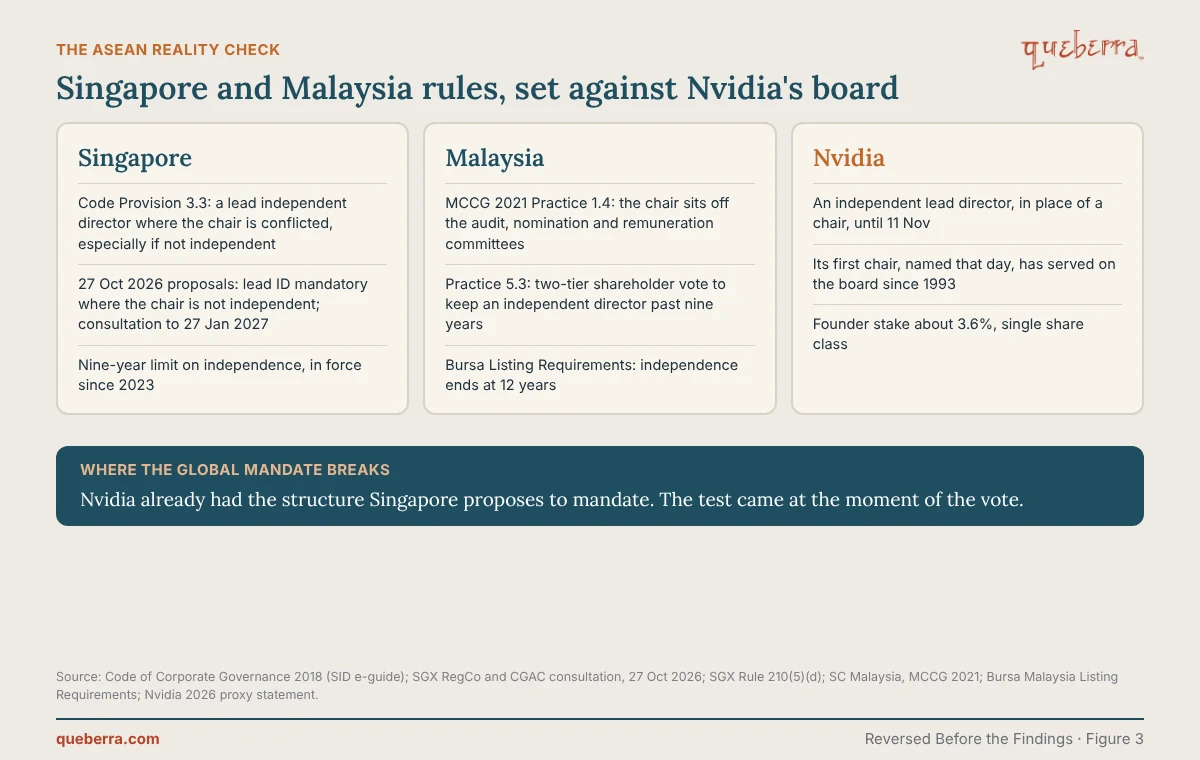
Singapore already asks the structural question. Under the Code of Corporate Governance 2018, the board should have a lead independent director where the chair is conflicted, and especially where the chair is not independent (Provision 3.3). Where there is a lead ID, they sit on the nominating committee (Provision 4.2). On 27 October 2026, SGX RegCo and the Corporate Governance Advisory Committee proposed going further:
- a mandatory lead ID where the chair is not independent;
- key committees chaired by independent directors;
- all committee members to be non-executive;
- a cap of five listed directorships.
Consultation closes on 27 January 2027.
Where the global mandate breaks. Nvidia appointed its first chair on the day its CEO left. That chair has served on the board since 1993. A lead-ID rule would not have changed the structure. Until 11 November, Nvidia already had an independent lead director in place of a chair. The structure existed. It did not test whether a director of 33 years’ standing can still act independently of a founder he has served alongside since before the company went public. S&P’s critique lands precisely on that gap: independence defined by status rather than demonstrated by behaviour. Singapore’s nine-year tenure limit for independent directors, in force since 2023, addresses the symptom. It cannot, on its own, address the dynamic.
Malaysia takes a different route to the same question. The Malaysian Code on Corporate Governance 2021 keeps the board chair off the audit, nomination and remuneration committees (Practice 1.4). An independent director who stays beyond nine years needs shareholder approval through two-tier voting (Practice 5.3). Bursa Malaysia’s Listing Requirements, amended in 2022, end independence altogether at 12 years. Both markets regulate status well. Neither rulebook can tell a long-serving director when a board reversal needs a dissent on the record.
Where local adaptation wins. In much of ASEAN, removing a founder is not a realistic option, whether the company is founder-controlled, family-held or state-linked. Those boards rarely face a binary choice. Their real tool is not removal. It is a pre-agreed protocol for how decisions about the founder are made, and unmade. That protocol is set before a crisis, not improvised during one.
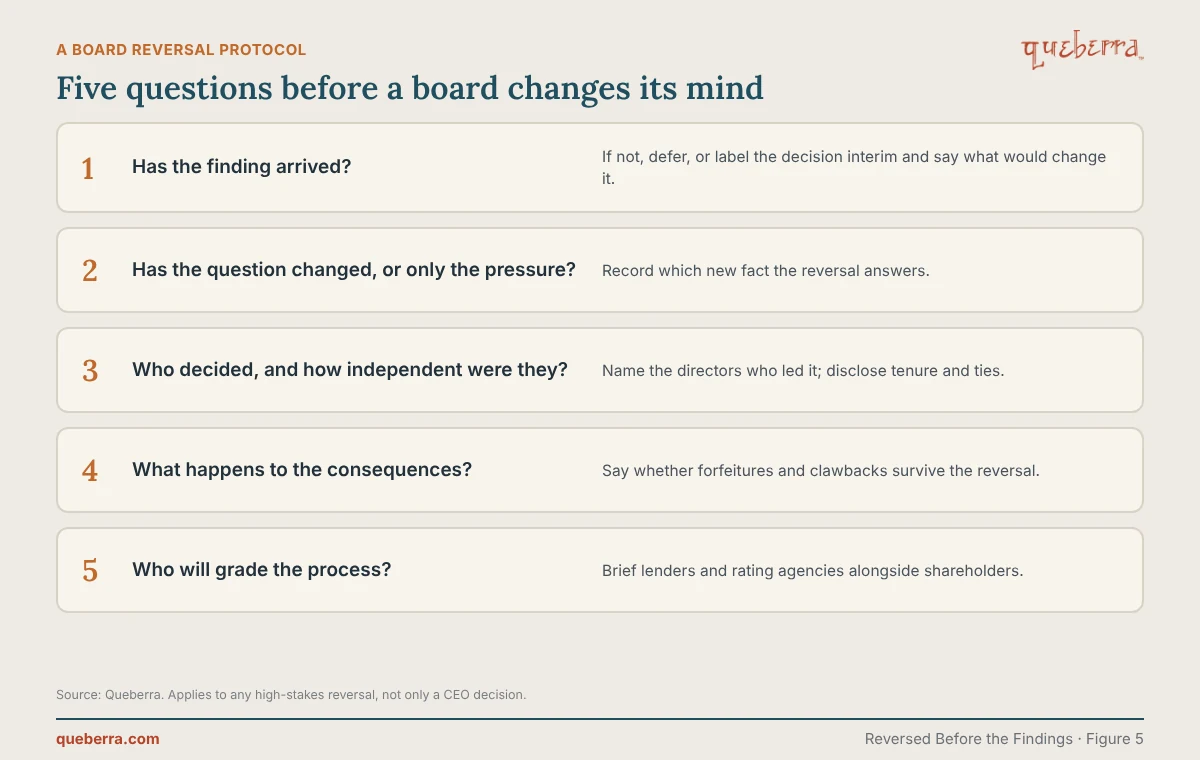
A board reversal protocol: five questions before a board changes its mind
We offer this as a working checklist for boards across the region. It applies to any high-stakes board reversal, not only one involving a CEO.
- Has the finding arrived? If the decision rests on an open inquiry, defer it, or state plainly that it is interim and what would change it.
- Has the question changed, or only the pressure? Record which new fact the reversal answers. Market reaction, political input and stakeholder petitions are inputs, not facts about the matter under investigation.
- Who decided, and how independent were they? Name the directors who led the decision. Disclose tenure and relationships, without waiting for a rating agency to do it.
- What happens to the consequences? Decide explicitly whether forfeitures, clawbacks and disciplinary outcomes survive the reversal, and say so.
- Who will grade the process? Brief lenders and rating agencies alongside shareholders. They are grading the board, not the CEO.
What we would watch next
- The investigation’s findings, and whether they are disclosed.
- The congressional sessions scheduled for 1–2 December 2026.
- A public hearing of the Senate Banking Committee, requested by its chair for 3 December 2026.
- S&P’s decision, due within 90 days of 25 November 2026.
- Any company filing on equity awards or board composition.
How other boards handled their moment
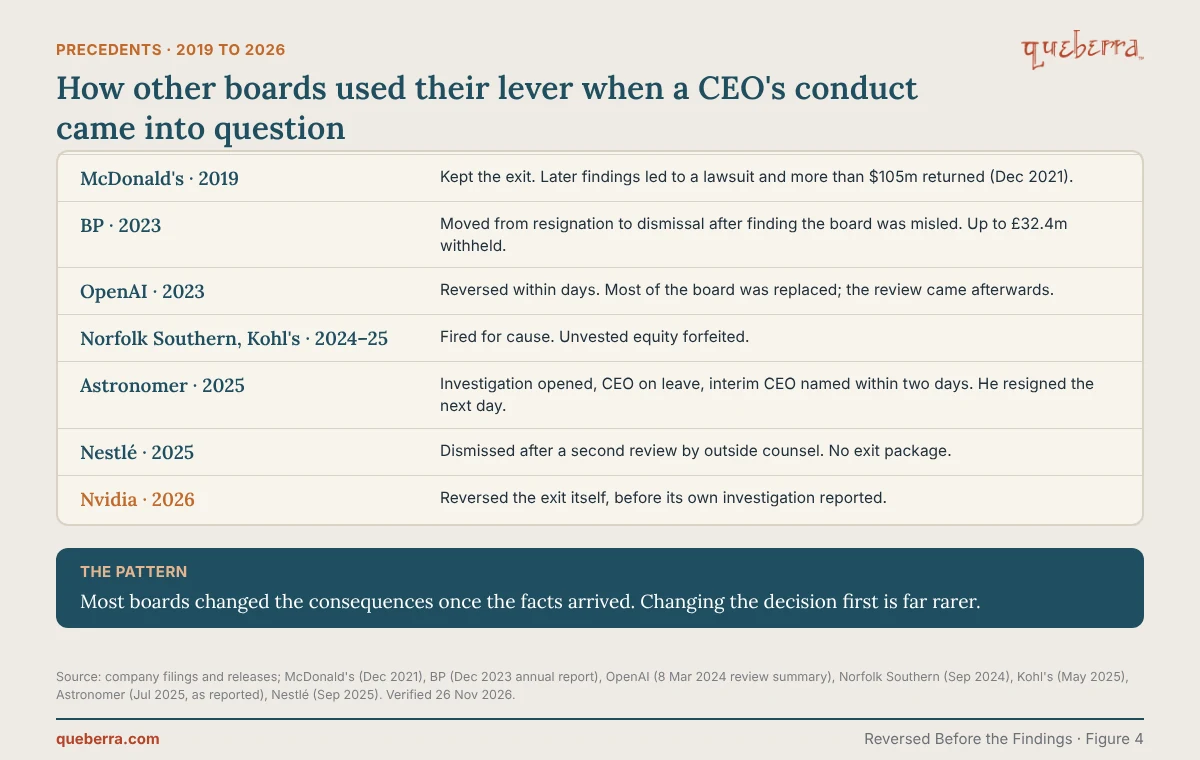
Nvidia is not the first board to face a CEO’s personal conduct. It may be the first to reverse the exit itself. The precedents are instructive less for what triggered them than for what the boards chose as their lever.
McDonald’s (2019): findings changed the consequences, not the decision. Steve Easterbrook left without cause and kept more than $40 million. Months later, the board found evidence he had concealed further relationships. It sued, and in December 2021 he returned more than $105 million in cash and equity. The board kept its decision and corrected its terms once the facts arrived.
BP (2023): the board found he had misled it. Bernard Looney resigned, then was dismissed for serious misconduct after the board concluded he had knowingly given it inaccurate assurances. Up to £32.4 million was withheld. Most of that was forfeited automatically on resignation; a smaller share followed from the dismissal and a discretionary clawback.
OpenAI (2023): the closest analogue. The board removed Sam Altman and reversed itself within days under pressure from employees and investors. The CEO returned; most of the board did not. An outside review followed after the decision, not before it. Its summary, published in March 2024, found the board had broad discretion to act but that Altman’s conduct “did not mandate removal.”
Norfolk Southern (2024) and Kohl’s (2025): clean exits, priced as such. Both CEOs were fired for cause, with equity forfeited and, at Norfolk Southern, no severance. Norfolk Southern’s shares barely moved. Kohl’s rose on the day, though earnings news was also in play.
Astronomer (2025): a pause first, with a named interim leader. In July 2025, a stadium “kiss cam” at a Coldplay concert caught chief executive Andy Byron embracing the company’s chief people officer, and the clip went viral. Within two days the board opened a formal investigation, placed him on leave and named a co-founder as interim CEO. He resigned the next day, and the board accepted. The first move was a pause with someone clearly in charge, a step the Nvidia record does not show.
Nestlé (2025): investigate first, then act. Laurent Freixe was dismissed over an undisclosed relationship with a direct subordinate after a second review led by outside counsel. There was no exit package. He is now contesting the forfeited bonus and shares in court.
The pattern is consistent. Where boards waited for findings, the findings decided the consequences, often in the board’s favour and sometimes years later. Where boards moved before the facts, the facts later rewrote the story. In the one comparable board reversal, it was the board that was replaced.
The takeaway
A board’s credibility does not rest on never changing its mind. It rests on being able to show why it changed. Nvidia’s directors may yet be vindicated by the findings. They chose not to wait for them.
A board’s word is worth what it costs to reverse.
A LinkedIn summary of this article, with the discussion around it: https://lnkd.in/p/gaw_hqb8
Related reading
- Heirs Learn in Class, Stewards Learn at the Table : Why Family Office Succession Needs a Mandate Before a Plan
- Boards Recruit for Fit, Then Fault the Gaps: Why Chemistry Without Capability Is a Governance Risk
- The “Passive” Board is Dead: Reimagining the Non-Executive Director in 2026
Frequently asked questions
Did Nvidia’s board reinstate Jensen Huang before its investigation finished?
Yes. The board voted to reinstate him on 22 November 2026, announced it the next day, and said its independent investigation would “proceed to conclusion.” No findings had been published.
How did Nvidia’s share price react?
It rose 31.5% on 23 November, from $125.53 to $165.05. That still left it about 31% below its 6 October record of $239.24. By 25 November it had eased to $149.30.
Why did S&P react differently from the stock market?
S&P’s concerns centred on the board: independence, director tenure, succession and dependence on one individual. Those concerns were not resolved by the CEO’s return.
What is changing in Singapore?
SGX RegCo and the Corporate Governance Advisory Committee proposed on 27 October 2026 that a lead independent director be mandatory where the chair is not independent. Key committees would be chaired by independent directors. Consultation closes on 27 January 2027.
What does Malaysia already require?
The Malaysian Code on Corporate Governance 2021 keeps the board chair off the audit, nomination and remuneration committees (Practice 1.4). An independent director who stays beyond nine years needs shareholder approval through two-tier voting (Practice 5.3). Bursa Malaysia’s Listing Requirements, amended in 2022, end independence at 12 years.
What should directors ask before a board reversal?
Five things:
- whether the finding has arrived;
- whether the question or only the pressure has changed;
- who decided, and how independent they were;
- what happens to the consequences;
- who will grade the process.
Sources
- Nvidia SEC filings and company releases, 11 to 23 November 2026; Nvidia 2026 proxy statement
- The New York Times (29 October 2026), as reported by CNBC; NPR (17 November 2026); Bloomberg Law (13 November 2026)
- Moody’s (18 November 2026) and S&P Global Ratings (25 November 2026) actions, as reported by Bloomberg and Reuters
- Nasdaq and Investing.com daily closes
- Singapore Code of Corporate Governance 2018; SGX RegCo and CGAC consultation (27 October 2026); SGX Mainboard Rules
- Malaysian Code on Corporate Governance 2021; Bursa Malaysia Main Market Listing Requirements
- Company statements and filings for McDonald’s, BP, OpenAI (review summary, 8 March 2024), Norfolk Southern, Kohl’s, Astronomer and Nestlé
Editorial note: we report allegations as the named outlets published them. As at 26 November 2026, Nvidia has not published findings from its investigation. This article is not investment advice.
—