
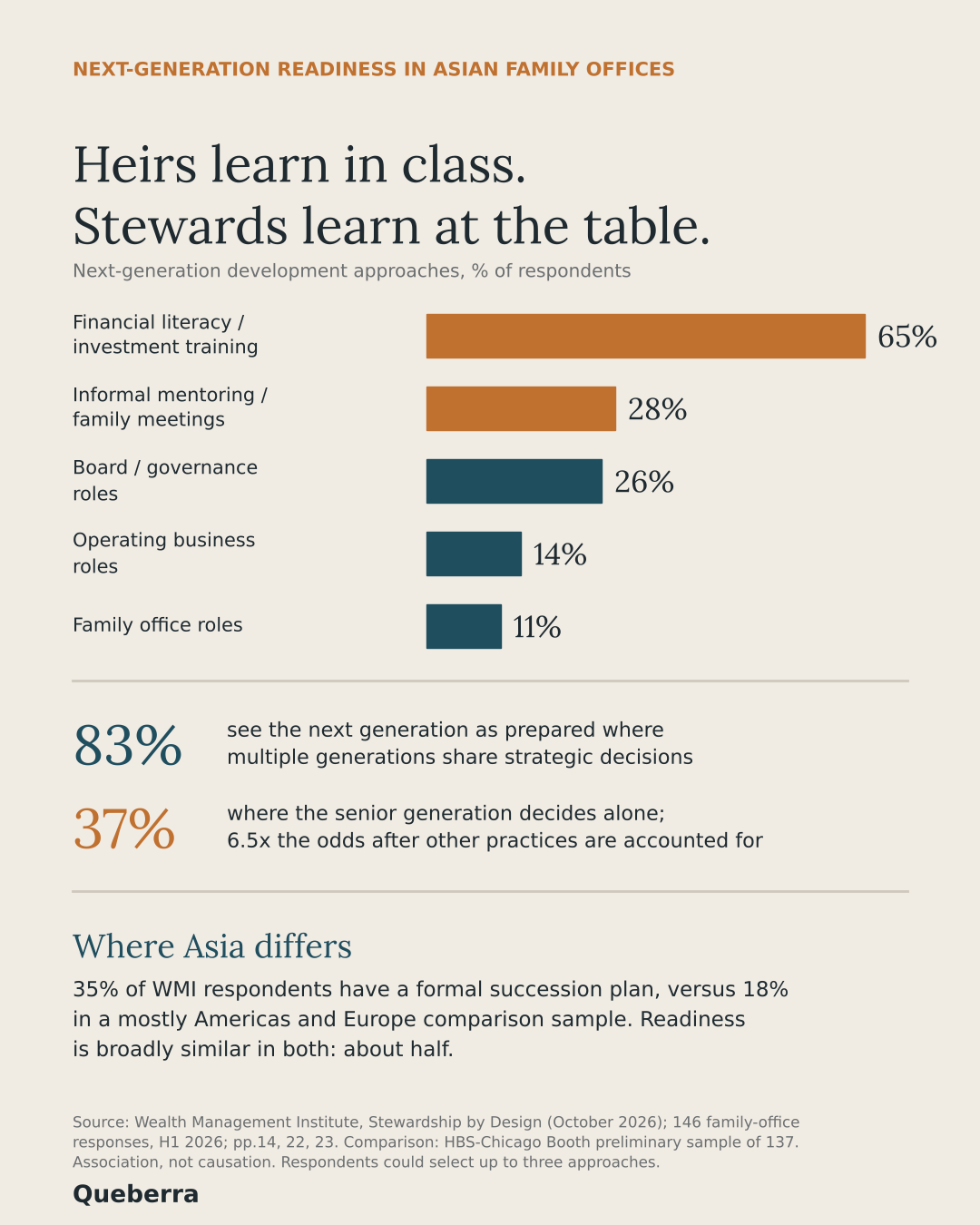
The LinkedIn summary of Stewardship by Design: Preparing Asia’s Next Generation for Leadership and Impact, the October 2026 report from Singapore’s Wealth Management Institute (WMI), led with one contrast. Family offices that share strategic decisions across generations see their next generation as prepared 83% of the time; where the senior generation decides alone, 37%. For family office succession, that is a sharper test than any written plan.
This article picks up where that summary stopped. It looks at what sits beneath the 6.5 times finding, how three different kinds of family office start from different places, what the philanthropy data add, and where the usual succession toolkit meets Asian realities. It closes with a one-page stewardship mandate and a twelve-month sequence a family board can use.
The LinkedIn summary in brief
- Intent runs ahead of readiness. About seven in ten respondents intend to pass wealth on, but only about half see the next generation as prepared (p.14).
- Learning is widespread, real roles are rare: 81% use at least one development approach and 65% offer financial literacy or investment training, but only 26% offer board or governance roles, 14% operating roles and 11% family-office roles (p.22).
- After accounting for other practices, cross-generational participation in strategic or operational decisions carries 6.5 times the odds of the next generation being seen as prepared (p.23).
- 35% of WMI respondents have a formal succession plan, against 18% in a Harvard Business School and Chicago Booth comparison sample, yet readiness is broadly similar in both (p.14).
- The three moves: give one bounded responsibility, turn a board seat from observer to contributor, and put a date on the plan.
The rest of this article is new ground.
What WMI asked, and whom
WMI surveyed 146 family-office principals and professionals in the first half of 2026. 84% are based in Asia-Pacific: Singapore 53%, Hong Kong 8%, Malaysia 7% and China 6% (p.9). The regression analysis uses the 126 responses for which next-generation readiness applied (p.9). WMI added 16 interviews with current- and next-generation family members, read alongside 22 earlier interviews with family-office principals and professionals, across 15 economies including Malaysia and Indonesia (p.9). Professor Lauren Cohen of Harvard Business School contributed to the questionnaire design (p.2).
The comparison sample of 137, mostly in the Americas and Europe, is preliminary and was shared only in aggregate; the two samples were not pooled, and WMI cautions against reading differences as caused by geography or culture (pp.8 to 9). Two further limits matter. Readiness is the respondent’s own assessment, not an independent test of capability. And every association in the report is just that, not proof of cause (p.24).
What sits beneath the 6.5 times finding
The headline multiplier hides a sharper distinction. When WMI separated participation into its parts, involvement in strategic decisions was more strongly linked to readiness than operational or oversight exposure alone. In WMI’s words, the difference is “between being close to consequential decisions and actually having a part in making them” (p.23). A seat in the meeting is proximity. A share in the decision is development.
The same pattern runs through the development approaches. Taken together, breadth helped: families using a wider range of approaches were more likely to report readiness. Taken one by one, board and governance exposure had the clearest link, while financial literacy and informal mentoring weakened once more experiential forms were considered (p.23). The instruction most families invest in is useful, but it is not what separates the prepared from the unprepared.
The comparison sample adds a contrast the summary did not cover. Informal mentoring or family meetings feature for 44% of the Harvard and Chicago Booth respondents, against 28% in WMI’s sample, while financial instruction features for 36% against 65% (p.22). WMI warns that this is not a cultural ranking. Our reading is practical: the families in WMI’s sample put heavy weight on instruction and comparatively little on the guided conversation that turns instruction into judgement.
Two further results matter for boards. Among succession approaches, plans with predefined timing were the clearest positive marker (p.24); a timetable does not build judgement, but it gives development a visible horizon. And governance structures, which looked helpful in simple comparisons, did not consistently hold up as independent predictors once involvement, development and planning were taken into account (p.23). WMI calls governance “enabling infrastructure for development rather than development itself”, and puts it plainly: “The structure creates the forum. The responsibility creates the development” (pp.23, 30).
The report’s first case study shows what the difference looks like in practice. A next-generation member who had worked outside the family joined the investment committee, but the seat “did not automatically confer decision-making authority”. He proposed an allocation; the senior generation committed less capital than he asked for and required quarterly reporting. When the portfolio suffered, the review asked him to explain what had happened, his reasoning and what he would do next. His responsibilities later widened to reviewing the family’s wealth-management providers and helping develop an investment policy statement (p.20). WMI’s term for the design is bounded responsibility: a decision material enough to require judgement, with limits, oversight and consequences proportionate to experience (p.20).
Three family offices, three starting points
The LinkedIn summary mentioned only the principal-centred office. WMI’s cluster analysis identifies three working profiles, formed from how offices are organised rather than from readiness: 50 principal-centred, 39 family-committee-led and 57 family-professional (p.45). WMI stresses that these are not stages of maturity, and that the differences are descriptive.
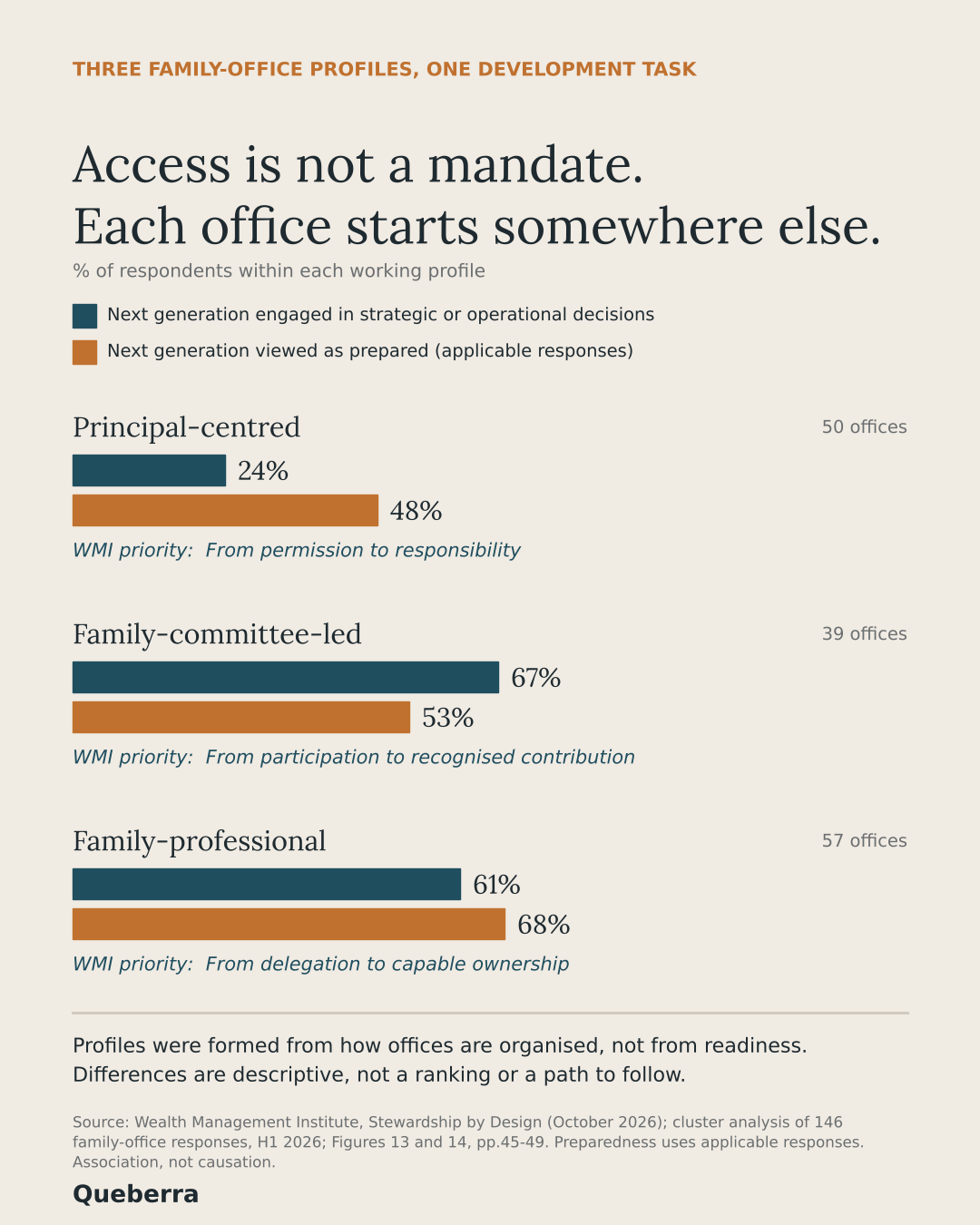
| Profile (pp.46 to 49) | Next generation in strategic or operational decisions | Next generation seen as prepared | WMI’s priority |
|---|---|---|---|
| Principal-centred | 24% | 48% | From permission to responsibility |
| Family-committee-led | 67% | 53% | From participation to recognised contribution |
| Family-professional | 61% | 68% | From delegation to capable ownership |
In principal-centred offices, 74% say the principal holds investment authority, and 62% name the principal’s preferences among the factors that most often guide decisions, against 28% of committee-led and 39% of family-professional offices (pp.46 to 47). Access to the principal is real; responsibility still depends on permission. Committee-led offices have the seat, but a seat can mean representation without contribution. Family-professional offices have capable teams, and the risk is that judgement is delegated along with execution. WMI’s line for them is worth repeating: “Delegating execution should not mean delegating judgement” (p.48).
The practical point is that the second of the three moves, turning a seat into a contribution, matters most for committee-led families, while the first, a bounded responsibility, matters most where authority sits with one principal.
Where philanthropy fits
Purpose shows up in what families commit. Among respondents that name philanthropy as a top non-financial goal, 71% devote 5% or more of family-office time and resources to philanthropy and impact, against 37% of the rest; WMI notes the base is small (p.38). Where the next generation is exposed to philanthropy as part of its development, 42% use quantitative impact measures, against 13% where it is not, and only 8% are unsure how to judge success, against 44% (p.42).
Money alone does not do the work. One family in the study offered younger members a charitable budget and received little response; providing resources did not, by itself, create purpose or responsibility (pp.21, 41). Philanthropy develops stewards when it carries a real outcome to answer for, not when it is used as a training ground.
Where the global mandate breaks, and where local adaptation wins
The global succession toolkit is structural: a family constitution, a council, a written plan. WMI’s data suggest that this toolkit is necessary but not sufficient, and in Asia it meets particular frictions: hierarchy, deference to elders, an inclination to avoid confrontation and the sensitivity of conversations about mortality (p.11). A charter does not dissolve deference. A seat at the table does not give a younger member the standing to disagree. One younger investor in the study could adjust holdings within an approved list, yet found it hard to challenge a position his father favoured (p.33).
Local adaptation wins by working through tradition rather than around it. In the report’s traditions-led Asian family, the younger steward served a long apprenticeship in which he prepared decision papers and recorded why choices were made. Later he brought his nephew into investment decisions and showed him how the reasoning was prepared (pp.27, 33). WMI’s distinction between tradition as memory and tradition as practice is the useful one (p.28). A family gathering that recounts the founder’s story builds connection. One where a younger member presents a recommendation and answers questions builds a steward.
The Malaysian example in the report points the same way. That family revisits its values periodically rather than treating them as fixed, and separates foundation capital from family investment capital, with different expectations on return and wider benefit (pp.40, 43).
For family-controlled companies listed on Bursa Malaysia, succession is also an investor question. The Securities Commission Malaysia and Bursa Malaysia MY Value Up Guidebook lists succession, together with board independence and competencies, among the governance strategies a company can set out in its plan (p.16). Its illustrative global examples include naming two successors for each critical role (pp.23 to 24). A named successor is a start. A tested one is what a minority shareholder will want to see.
Beyond the summary: the Queberra Stewardship Mandate
The LinkedIn summary proposes three moves. In practice they come together on one page for each family member taking on responsibility. At Queberra, we call this the Stewardship Mandate: a working framework built from WMI’s decision-rights test (p.33) and its operating questions (p.49), not a WMI template.
- Contribution: the genuine family need the role serves, and why this person.
- Decision area: what the person may decide alone, and within what limits of capital, time or risk.
- Consultation: which decisions need the senior generation’s view before action, and which still need approval.
- Review: who examines the reasoning, how often, and what record is kept.
- Recognition: who outside the family must know the person can decide, such as executives, advisers and private bankers.
- Continuity: who else understands the work if this person is unavailable.
- Next horizon: the date the mandate is reviewed and could widen.
The page works because it turns an intention into a decision right with a review date. It also exposes the gap in the report’s fifth case study: a founder whose confidence in his children had grown, yet who still made practically all investment decisions himself, and who kept a record of past investments he had not yet taken them through (p.32). Confidence and delegation are different stages. The mandate is how one becomes the other.
A twelve-month sequence for the family board
- Meeting one: list every decision the senior generation still takes alone. Do not debate succession. Ask which one could be shared within limits.
- Meeting two: agree one bounded mandate for each next-generation member, using the page above.
- Meeting three: hold the first review of reasoning, not results, with the adviser who knows the area in the room.
- Meeting four: tell the people affected, including executives, advisers and banks, who can now decide what. WMI’s test is whether a delegated decision brought back to the senior generation is returned or reopened (p.34).
- Annual cycle: put a date on the succession plan and widen or adjust each mandate against it (p.24).
How the lens shifts by type of board
- Founder-led single-family offices: start with one decision, not a programme. The risk is a permanent apprenticeship in which the next generation learns everything except how to decide.
- Family-controlled listed companies: next-generation readiness becomes a question for minority shareholders and for the Value Up plan. Independent directors can ask how successors are being tested, not only who is named.
- Private equity and co-investors in family firms: ask for evidence of successor discretion, meaning decisions the next generation has actually made and how they were reviewed, alongside the governance documents.
- Advisers and private banks: only 32% of WMI respondents name external advice among the top three factors guiding decisions (p.52). A separate 2026 study of 1,049 NextGen private-banking clients in Singapore and South-East Asia, cited by WMI, found that 71% have their main banking relationship with a different bank from their parents (p.52). Relevance has to be earned again with each generation.
Questions to take into the next family board meeting
WMI sets out five questions for continuity (p.35). Put to a family board, they read as follows:
- Decisions: if the principal were unavailable tomorrow, who could make the next important decision rather than postpone it?
- Judgement: who else can explain why the family’s largest commitment was made, and recognise when its assumptions no longer hold?
- Challenge: how does a younger member question an established approach through an agreed process, so that it never becomes personal?
- Relationships: do the family’s key advisers and partners know more than one family member who can act?
- Capacity: are responsibilities shared among people with complementary strengths, with someone able to step in where continuity matters?
A note on method
Percentages are taken from the report’s figures and text, with printed page numbers. WMI and HBS-Chicago Booth figures come from separate surveys; WMI received only aggregated comparison results and treats them as indicative (p.8). Profile percentages are within each profile, and readiness uses applicable responses only (p.46). This review does not use the report’s charts on governance bodies and investment authority, where the published layout makes it hard to pair each figure with its sample with confidence. This article is general commentary, not legal, tax or financial advice.
The Boardroom Takeaway
A succession plan names who will receive. A mandate shows who can steward. Families that wait for the transfer date to find out have chosen the hardest moment to learn. A family can schedule an inheritance. It cannot schedule judgement.
Which decision did your next generation make, and defend, this year?
This article was first shared on LinkedIn: https://lnkd.in/p/g_bTUe7S
Related reading
- Boards Recruit for Fit, Then Fault the Gaps: Why Chemistry Without Capability Is a Governance Risk
- The “Passive” Board is Dead: Reimagining the Non-Executive Director in 2026
- Hindsight Is a Case Study, Foresight Is a Culture : Why Boards Cannot Forecast the Next Shock but Can Prepare to Hear It
Sources
- Wealth Management Institute, Stewardship by Design: Preparing Asia’s Next Generation for Leadership and Impact, October 2026.
- Wealth Management Institute, Asia’s Succession Moment: Closing the Planning Gap to Safeguard Legacy, 2025.
- Securities Commission Malaysia and Bursa Malaysia, MY Value Up Programme Guidebook, 1st Edition, June 2026.
- Christoph, K. and Claude, B., Shaping the Future of Wealth Management: NextGen Private Banking Clients 2026, Singapore Edition, as cited by WMI (p.52).