
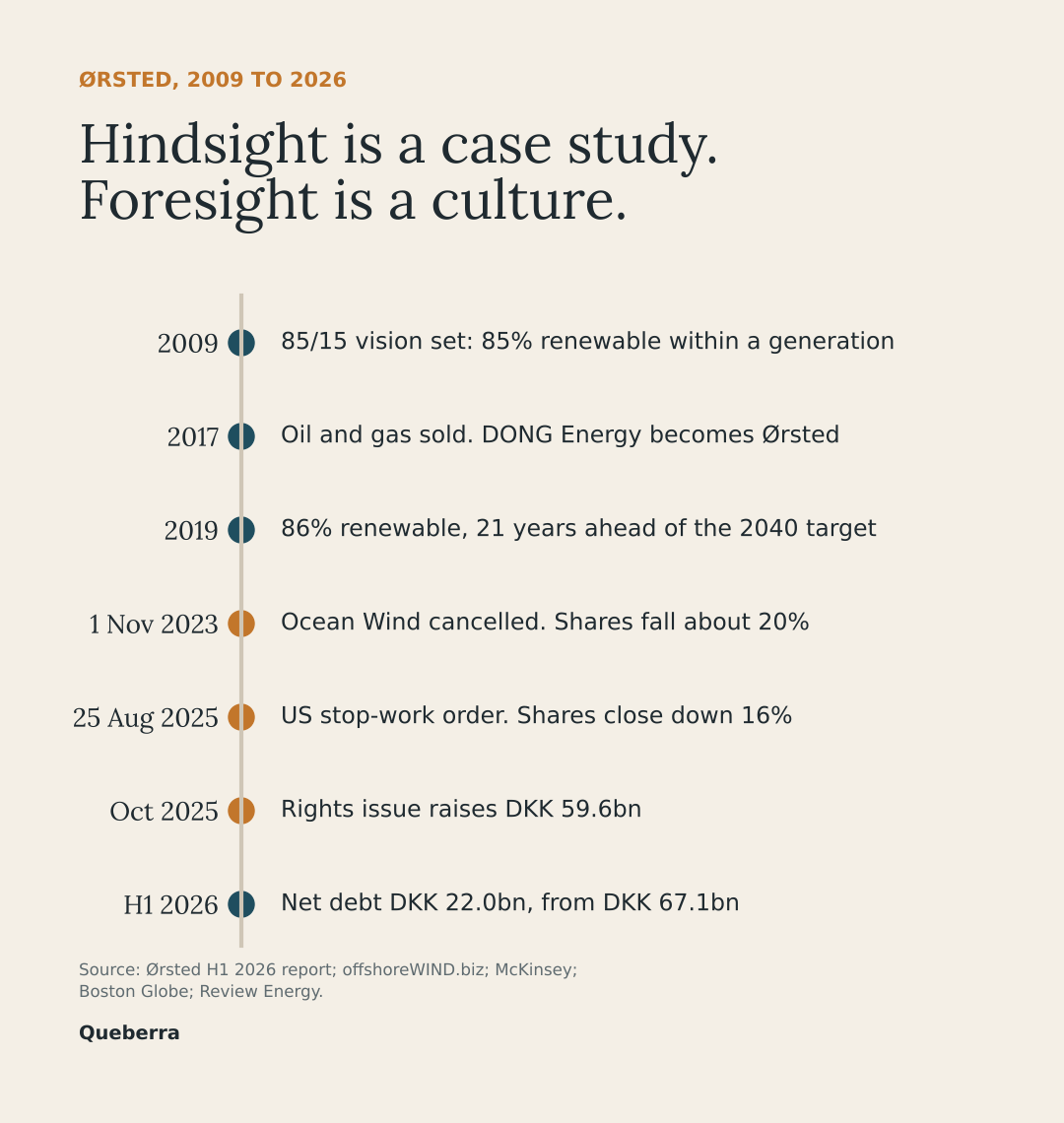
In 2019, 86% of Ørsted’s heat and power generation was renewable. On 1 November 2023, its shares fell about 20% in a single day. Same company, same strategy, same board. Only the ending changed. Hindsight is a case study; foresight is a culture.
We kept returning to that contrast during a masterclass organised by Climate Governance Malaysia at Bursa Malaysia on 13 October 2026. Roshan Thiran, founder of Leaderonomics, argued that transformation starts with the climate inside an organisation. Datin Seri Sunita Rajakumar moderated. He drew on GE Engine Services Malaysia in Subang, Kodak, Nokia, DONG Energy (now Ørsted) and Leaderonomics itself.
What follows is our reading of his reading. The cases and the lens are his. The interpretation, and the observation about AI near the end, are ours. We have written only about the cases we could check against public sources, and leave Subang to the people who worked there.
The Inside-Out Lens
Roshan’s three terms, which he has also set out in his writing on AI and culture:
- Code: the visible playbook (systems, routines, strategy).
- Core: the invisible identity (beliefs, trust, what people do when nobody is watching).
- Cargo: what the organisation delivers (results, impact, value).
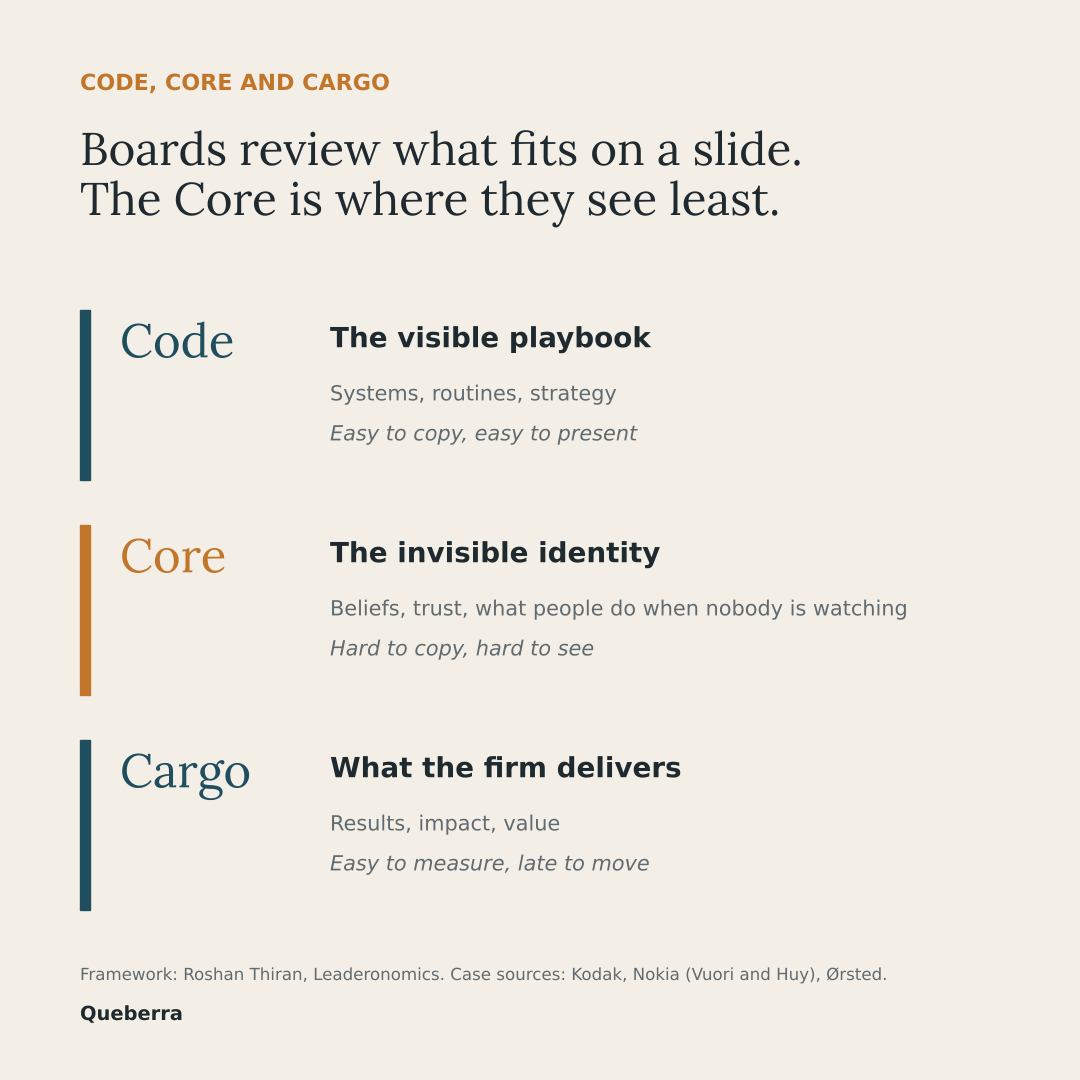
A competitor can copy a strategy deck by lunchtime. It cannot download the trust that lets bad news travel upward. Boards tend to review Code and Cargo, because both fit on a slide. The Core is where they see least.
What the record shows
Kodak. Steven Sasson built the first digital camera at Kodak in 1975. The Code existed. Kodak filed for bankruptcy in 2012. The technology was not the missing piece.
Nokia. Timo Vuori (Aalto University) and Quy Huy (INSEAD) studied the company in Administrative Science Quarterly. They found fear between management layers: middle managers feared upper management and hid unfavourable issues, which blocked corrective steps. Bad news was not missing. It simply did not rise.
Ørsted is the richest of the three, because its story is still being written. Around 2009, executives set an “85/15 vision”: reverse a generation mix of 85% conventional and 15% renewable. McKinsey records that the board backed the renewable agenda, and that employees pushed back hard, since the company had built its reputation on fossil fuels. Financial pressure in 2012 made offshore wind easier to accept. In 2017 it sold its oil and gas business and DONG Energy became Ørsted, on 6 November. By 2019, 86% of its generation was renewable, 21 years ahead of the 2040 target.
Then the ground moved. On 1 November 2023, Ørsted cancelled Ocean Wind 1 and 2 in the United States, took an impairment of DKK 28.4 billion, and saw its shares fall about 20% to an all-time low. In August 2025, a US stop-work order halted the almost-finished Revolution Wind project, and the shares closed 16% lower on 25 August. In October, a rights issue raised DKK 59.56 billion, with the Danish state taking up about half of the new shares. By the H1 2026 report, net interest-bearing debt stood at DKK 22.0 billion, from DKK 67.1 billion a year earlier, and Ørsted said it would reinstate a dividend for financial year 2026.
The fair reading is neither triumph nor collapse. The transformation faltered under external shocks, then the balance sheet was rebuilt. It is not finished.
Hindsight and Foresight: why foresight is a culture, not a forecast
Every case reads clearly once the ending is known. Ørsted was a model in 2019 and a warning in 2023. The same facts support both stories. A case study is written after the ending, and the people who lived it were deciding without one.
Our own observation, for the AI era: the game changers are having the game changed on them. One week after DeepSeek released its R1 model in January 2025, Nvidia lost US$589 billion of market value in a single day, which Harvard Law School describes as the largest single-day loss in history. How DeepSeek achieved its results remains contested. The point does not depend on the answer. The company at the centre of an era is no safer from surprise than the one it displaced.
If foresight cannot be built from forecasts, it has to be built from something else. The inside-out lens points to the Core.
The ASEAN Reality Check
These cases come mostly from Nordic, Finnish and American firms. They assume a culture in which a middle manager can contradict a senior one. In high-context boardrooms across ASEAN, bad news is often softened by courtesy before fear filters it, so the Nokia pattern is easier to reach here, not harder.
The disclosure data points the same way. Malaysia’s first mandatory climate-disclosure cycle averaged 54.6% disclosure quality across 91 listed companies, according to MSWG and Climate Governance Malaysia. A framework records what is reported. It cannot record what goes unsaid.
This is where the global mandate breaks. It assumes candour can be requested. In a relationship-led setting, candour has to be designed. And this is where local adaptation can win: courtesy is a strength when it carries a channel. Respectful, pre-agreed routes for a red flag turn deference into early warning.
What a board can do on Monday
- Name the assumption nobody may doubt. Every transition plan has one. Ask for it by name, and give a director the job of testing it.
- Agree the change-of-course triggers while calm. Which policy, cost-of-capital or partner event would make the board revisit the plan?
- Hear from two layers down, without management in the room, at least twice a year.
- Reward the early flag. Record who raised a problem first, and what happened to them.
- Review the Core as often as the Code. Put trust, candour and the speed of bad news on the dashboard beside the financials.
The Boardroom Takeaway
Plans age. The Core is what absorbs the surprise.
When did your board last hear bad news from below, unsoftened?
This article is Queberra’s reflection on a public session and on public sources, as read on 13 October 2026. It is general commentary, not legal or financial advice.
This article was first shared on LinkedIn: https://lnkd.in/p/g8zvetzP
Related reading
- Malaysia’s First NSRF Cycle: Boards Can Describe Climate Risk. They Cannot Yet Price It.
- Boards Recruit for Fit, Then Fault the Gaps: Why Chemistry Without Capability Is a Governance Risk
- The “Passive” Board is Dead: Reimagining the Non-Executive Director in 2026
Sources
- Ørsted, H1 2026 interim report announcement, 13 August 2026.
- offshoreWIND.biz, Ørsted rights issue, 7 October 2025.
- McKinsey, Ørsted’s renewable energy transformation.
- Aalto University, on Vuori and Huy, Administrative Science Quarterly.
- Harvard Law School, DeepSeek, ChatGPT and the global fight for technological supremacy.
- Share-price reports: Boston Globe, 25 August 2025; Review Energy, 2 November 2023.
- Roshan Thiran, Leaderonomics, LinkedIn post on AI and the inside-out model.
- MSWG and Climate Governance Malaysia, first-wave National Sustainability Reporting Framework review.