

A new framework from Stanford’s Doerr School of Sustainability exposes a significant vulnerability in how corporate boards measure environmental risk. For the last decade, corporate ESG efforts have tracked carbon emissions with near-surgical precision. Water stewardship has remained a blind spot, confined to vague, qualitative narratives.
The disparity in disclosure is stark: while 14% of major global companies report greenhouse-gas emissions, only 9% disclose total water withdrawals, and a mere 1% report on recycled-water use.
The GloCal Reality Check:
Traditional ESG water metrics fail because they treat a global commodity as if it behaved like a local one — and Stanford’s new Water Sustainability Index changes the underlying maths:
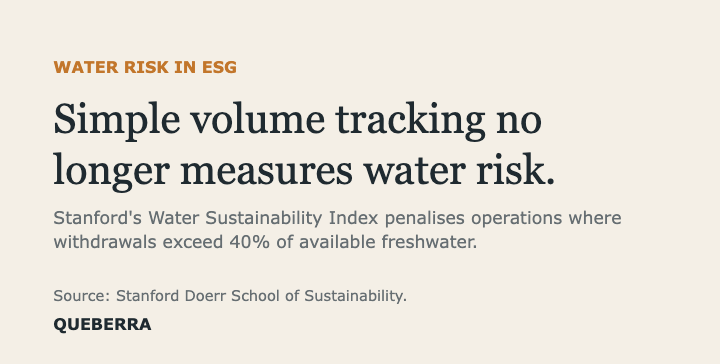
- Carbon is global; water is hyper-local. Withdrawing a million gallons from a rain-abundant region carries a fundamentally different risk profile than withdrawing it from a drought-stricken basin. Simple volume tracking misses that nuance entirely.
- The shift to scarcity-weighted maths. The new index penalises companies depleting scarce local resources — specifically operations in stressed watersheds, where withdrawals exceed 40% of available freshwater, and heavy reliance on slow-to-replenish groundwater.
- A financial calculator for sustainability. The index is not only an environmental grade; it is a financial tool, letting executives scenario-test capital investments and calculate, before committing capital, exactly how process-water reuse or water-quality upgrades will move their sustainability score.
For ASEAN boards operating across widely different watershed conditions — from water-stressed parts of the region to areas of relative abundance — a single global water-volume figure has always concealed more than it revealed. A scarcity-weighted index finally gives boards a number that maps to actual local risk.
The Boardroom Takeaway:
The era of greenwashing a water footprint is over. A board relying on uniform, opaque algorithms that treat all water equally is working from a risk assessment that is fundamentally flawed.