

A recent Harvard Business Review interview with Bob Sternfels, Global Managing Partner of McKinsey & Company, carries operational numbers that are worth boards’ full attention. This isn’t a pilot programme. It’s a platform shift, and the firm most identified with the billable hour is restructuring its own P&L around it.
The Executive Summary:
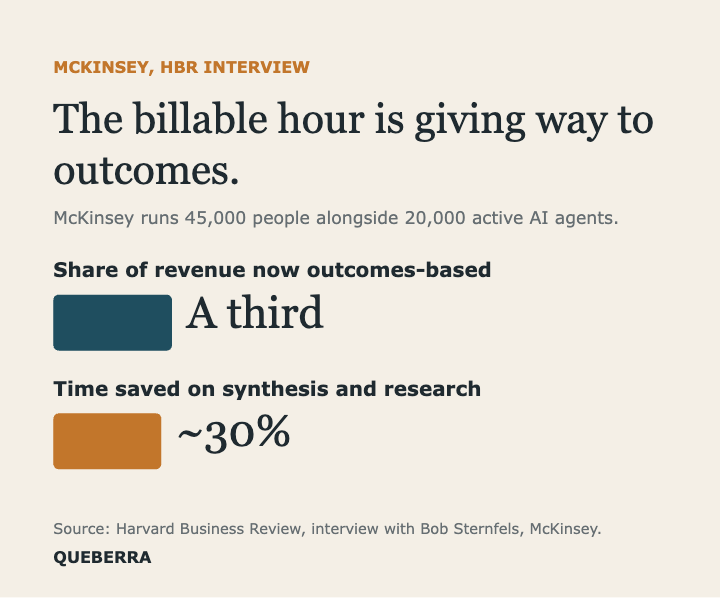
- The “bionic” workforce — McKinsey now runs 45,000 humans alongside 20,000 active AI agents, including its internal platform Lilli, saving roughly 30% of time on synthesis and research and freeing humans for high-touch judgment.
- The death of fee-for-service — a third of McKinsey’s revenue is now outcomes-based rather than time-based; as AI commoditises analysis, clients increasingly pay for the value created, not the slides produced.
- The resilience hiring filter — McKinsey found its traditional hiring biased toward perfect credentials, and has pivoted toward explicitly screening for resilience — candidates who had a setback and recovered — over pure case-cracking skill. When AI can produce the “perfect answer,” the human premium is grit.
The GloCal Reality Check:
If the world’s largest strategy firm is moving away from selling time, the procurement model many ASEAN organisations still use for professional services — hours billed against a scope — is already behind the market it is buying from.
The Boardroom Takeaway:
We are moving from buying effort to buying impact. Boards that continue to evaluate advisory and professional-services spend purely on hourly rates are measuring the wrong variable.