

Malaysia’s largest listed companies are about to write down, for the first time, how they intend to close the gap between what they earn and what the market pays. The programme is called MY Value Up. A paper published on 27 October by Aurelio Gurrea-Martínez, Joon Hyug Chung and Nydia Remolina, working through the Singapore Capital Markets Initiative at Singapore Management University and published as ECGI Law Working Paper 974/2026, gives us the first regional yardstick to read it against.
What the paper concludes
The authors treat value-up initiatives as a valuable governance tool and then draw a line around them: they are complements to, not substitutes for, effective legal and enforcement mechanisms for protecting investors. Disclosure raises the reputational cost of decisions that are hard to justify, particularly where control is stable. It does not create an active shareholder base where none exists.
The design comparison
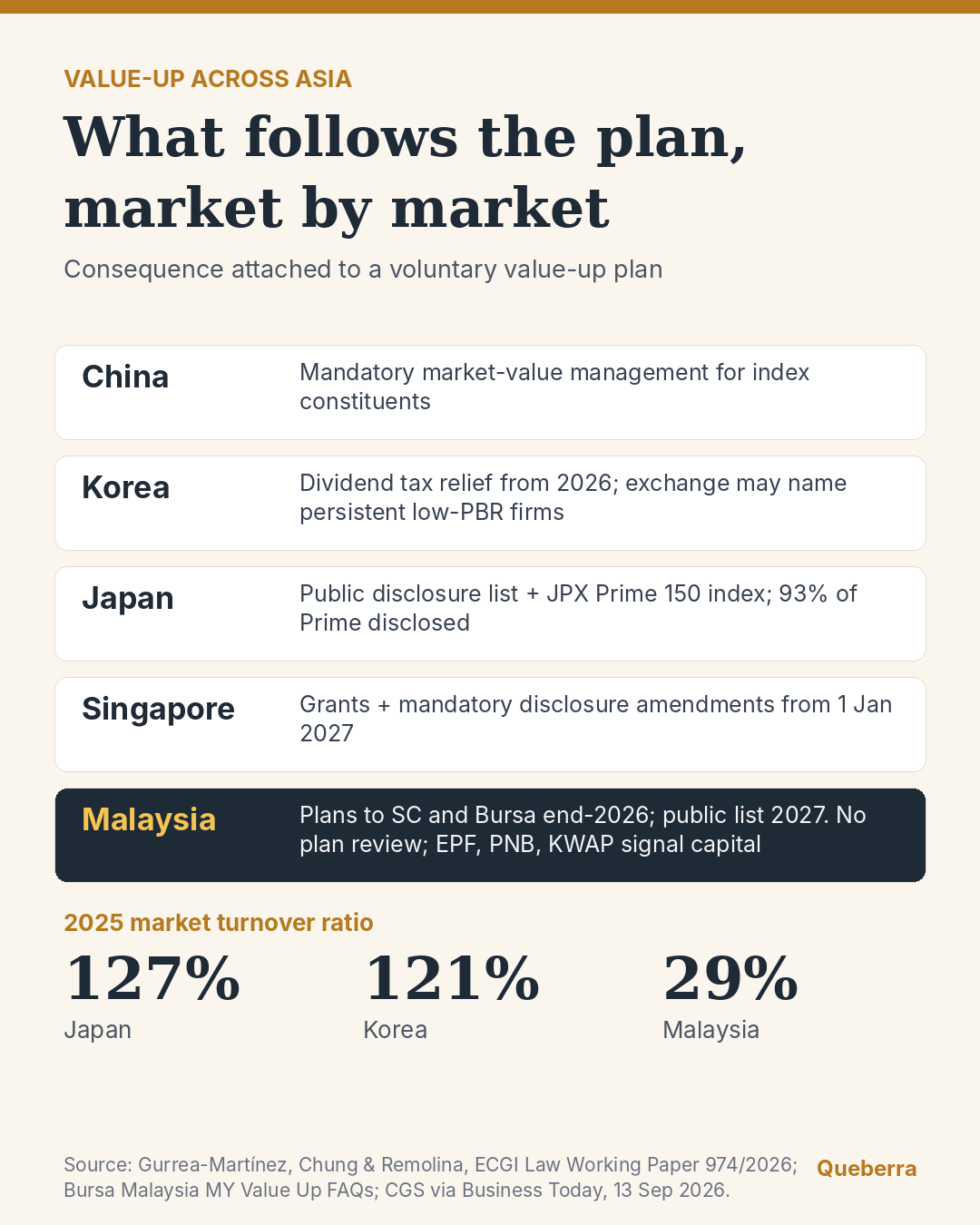
All seven markets examined began from the same request: explain how capital is allocated. They differ in what is attached to the explanation.
| Market | Design as reported in the paper |
|---|---|
| China | CSRC guidelines (November 2024) make market-value management systems mandatory for index constituents |
| Korea | Voluntary guidelines from 2024; separate taxation of qualifying dividends from 2026; exchange framework allowing persistent low-PBR firms to be publicly identified, first list due November 2026 |
| Japan | Exchange request of March 2023; JPX Prime 150 index; public list of disclosers. By end-February 2026, 93% of Prime companies had disclosed |
| Taiwan | Power Up zone; 487 companies by end-2025 |
| Thailand | JUMP+ programme, 2026 to 2028 |
| Singapore | Value Unlock grants; SGX RegCo amendments effective 1 January 2027 covering dividend policy, investor-relations policy and engagement activity |
| Malaysia | See below |
Where Malaysia sits
The MY Value Up Guidebook (Securities Commission, June 2026) asks the 88 companies above RM4 billion in market capitalisation, together over 80% of the market, to submit plans to the SC and Bursa by end-2026, with voluntary public release and a published list of participants from 2027 (The Star, 8 September, also reports a dedicated micro-site). Bursa’s FAQ is explicit on three points:
- The SC and Bursa Malaysia do not review or approve plans. Board and management remain accountable for formulating, approving and executing them.
- Companies in the target group are expected to participate; the scope of mandatory participation may be reassessed at the end of 2027.
- From 2028, there are “considerations” to move to mandatory disclosure, if the need arises.
On 9 June, Deputy Prime Minister Ahmad Zahid Hamidi announced that EPF, PNB and KWAP will allocate a portion of their capital to support companies committed to value creation; no amount was given (Bernama). The Star reports that Bursa is considering a dedicated MY Value Up index. Bursa’s chief executive has said the exchange is looking at incentives but that the focus remains genuine commitment (Bernama, 30 July). ACGA has argued the guidebook is directionally right but too light. We note both views. We would add only that Malaysia’s current design is the one in this group that relies most on the board’s own discipline.
What a MY Value Up plan asks of the board
The paper sets out the process the Guidebook describes (pp.23 to 24). A company first gives an overview of its business model, markets, financial performance and capital structure. It then analyses its current state with indicators such as return on equity, return on invested capital and the spread between returns and the weighted average cost of capital. On that basis it develops strategies in three areas: governance and corporate vision; resource allocation, including growth investment, portfolio rationalisation, balance-sheet management and shareholder returns; and communication with investors. It then reviews implementation and publishes annual updates explaining progress, any departures from the plan and the reasons for them.
Two features matter for directors. The return-versus-cost-of-capital spread is a test the board sets for itself. And the annual update creates an explain-the-departure loop with no external examiner.
Voluntary programmes since 2022, and one unchanged number
Malaysia was early. Bursa’s PLCT Programme launched on 2 March 2022, with five digital guidebooks and a public dashboard of participants that ran to the end of 2025. Its ambitions were broader than valuation, and MY Value Up moved the country closer to the valuation-focused model (pp.22 to 23). The paper notes that MY Value Up itself is still in implementation, that indicators point in different directions and that observation periods are short (p.33).
The OECD’s Asia Capital Markets Report 2026, which the paper draws on, counts Malaysia’s programme as running for more than three years, which places most of its measurement window before MY Value Up’s April 2026 launch. It reports annualised index growth of 2% and a median price-to-book ratio broadly unchanged at around 0.9, and says this may indicate limited impact on valuation. A median of 0.9 means the typical listed company trades below its book value.
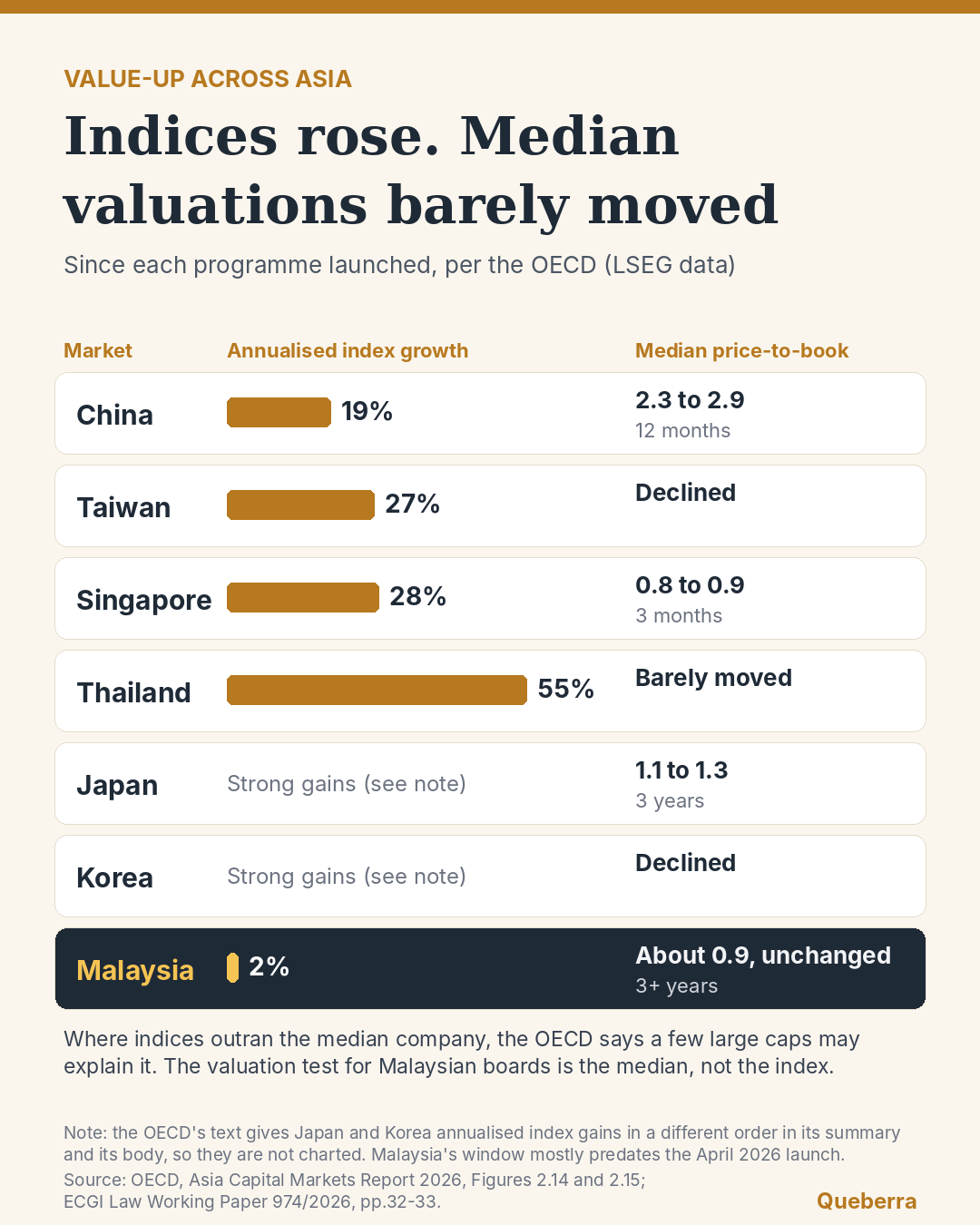
Other markets show a second pattern. In China the median price-to-book ratio rose from 2.3 to 2.9 in the twelve months after the November 2024 guideline. In Japan it moved from 1.1 to 1.2 after one year and 1.3 after three. In Korea and Taiwan it declined, despite strong index performance. The OECD says this may mean a few large companies drove the index returns while valuations across the broader market did not improve. The index is not the test, and the median is.
Why the ownership data matters
The paper reports that in about 52% of Asian listed companies the three largest shareholders hold more than half of the equity, against 44% globally, and that institutions hold about 21% of Asian listed equity, against 47%. For a plan with no reviewer, the audience is the register. Where a controlling shareholder is on it, that holder is the reader whose view moves capital allocation.
The paper also reports 2025 turnover ratios of about 266% in China, 127% in Japan, 121% in Korea, 99% in Taiwan and only about 29% in Malaysia (OECD, cited on p.33). The authors caution that attribution is confounded, and so should we: turnover reflects liquidity and investor base as well as reform.
What we would do in the boardroom
- Treat the plan as an accountability document. No regulator will mark it, so investors will.
- Choose targets the board can explain if missed. Bursa’s FAQ protects reasonable, good-faith disclosure; it does not protect vagueness.
- Anchor the plan in the indicators the process itself names, return on invested capital against the cost of capital, and report your own price-to-book against a Malaysian median of about 0.9.
- Connect the plan to capital allocation decisions already on the board’s calendar, and report against them.
- Test the plan with the controlling holder first, then with minorities.
- Draft the annual update’s section on departures from the plan before you need it, and plan for 2028 as if disclosure were mandatory.
Where no regulator marks the paper, the register does.
Related reading
- Our earlier note on the SC Guidebook and the board’s role (LinkedIn)
- Heirs Learn in Class, Stewards Learn at the Table : Why Family Office Succession Needs a Mandate Before a Plan
Sources
- Gurrea-Martínez, A., Chung, J. H. and Remolina, N., Value-Up Initiatives as a Strategy for Corporate Governance and Capital Market Development: Lessons from Asia, ECGI Law Working Paper No. 974/2026, doi:10.67929/ecgi-law-974-2026
- Bursa Malaysia, MY Value Up Programme FAQs and Guidebook page
- Securities Commission Malaysia, MY Value Up Guidebook release, 9 June 2026
- OECD, Asia Capital Markets Report 2026, chapter “Creating value and increasing trust”, Figures 2.14 and 2.15 (LSEG data)
- Bernama, 9 June 2026 (Ahmad Zahid Hamidi, Invest Malaysia Kuala Lumpur) and 30 July 2026; The Star, 8 September 2026; ACGA, 18 June 2026
First shared on LinkedIn.